
Quick Summary
Most falls do not cause serious injury, but the ones that do can hide, so the job in the hours and days after a fall is to watch rather than assume. Call 911 for loss of consciousness, a severe or worsening headache, repeated vomiting, slurred speech, new weakness, a deformed limb, or an inability to get up. After any blow to the head, seek care promptly even if the person feels or appears fine, because bleeding in the brain can be delayed and blood thinners are a reason for extra caution.1,2 Some serious injuries stay quiet, such as a hip fracture that does not always show up on the first X-ray.3,4 Confusion is its own warning sign: new or fluctuating confusion that comes on over hours or days can be the first signal of a serious problem in an older adult.5 Additionally, if a person who fell was alone on the floor for a long time, treat that as its own medical event.6 When in doubt, call 911.
Medical disclaimer
This article is general information, not medical advice, and it cannot diagnose an injury. When in doubt after any fall, call your doctor or 911. If someone has trouble breathing, is unconscious, or may have a serious injury, call 911 first.
On this page
Why symptoms can be deceiving · Emergency signs (call 911) · Broken bones that hide · Was it a trip or a faint? · When someone falls alone · The symptoms with no X-ray · A simple framework · How fast help closes the gap · For caregivers · FAQ · References
Why symptoms after a fall can be deceiving
More than one in four adults aged 65 and older falls each year, and most of those falls cause no lasting harm.1 That is reassuring, and it is also the reason the dangerous minority slips through. When nothing looks broken and the person says they feel fine, it is natural for them or their caregivers to move on. The trouble is that some of the most serious consequences of a fall are the ones you cannot see at the moment it happens.
Two things make symptoms after a fall easy to miss. The first is biology: a slow bleed in the brain, or a hairline fracture such as in the wrist or hip, can take hours to declare itself. The second is human nature. Many older adults play down a fall, partly from a wish to stay independent and partly from not wanting to alarm their families. Memory or cognitive changes can blunt self-reporting even further, so “I’m fine” is a starting point to verify, not a diagnosis to accept. The goal of this guide is simple: know which signs mean act now, which mean call today, and which mean watch closely, so a quiet symptom right now does not become a crisis later.
Emergency symptoms: when to call 911
A handful of signs mean the situation needs emergency care without waiting to see whether it passes. If any of the following appear after a fall, call 911 and keep the person still and warm until help arrives.
- Any loss of consciousness, even for a few seconds.
- A severe headache, or one that keeps getting worse.
- Repeated vomiting, a seizure, slurred speech, or sudden confusion.
- New weakness or numbness, especially on one side, or trouble speaking or seeing.
- A visibly deformed or badly painful limb, or an inability to move a part of the body or to bear weight.
- Bleeding that will not stop, or a fall from a height or down a flight of stairs.
- The person cannot get up, or was found on the floor after a long time down.
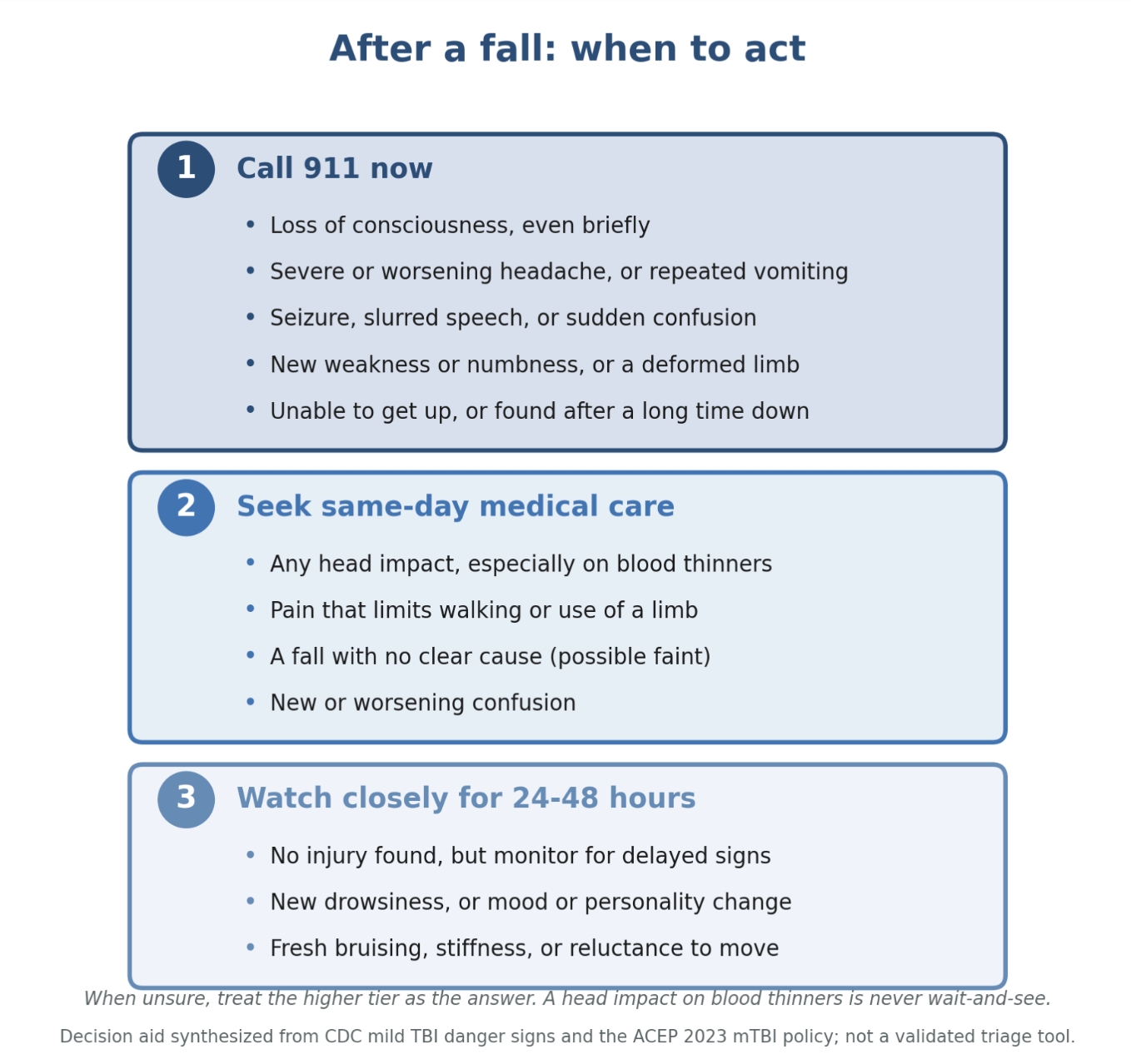
Figure 1. A quick triage guide for symptoms after a fall. When unsure, act on the higher tier.
The figure above sorts the most common signs into three tiers. It is meant as a fast reference, not a substitute for clinical judgment, and the guiding rule is to round up: if a symptom could belong in two tiers, treat it as the more urgent one. When in doubt, the safest choice is to call 911.
Head injuries: the symptoms that can be delayed
Head injury is the category that is easiest to underestimate, because the danger does not always show up at the scene. Falls are the leading cause of traumatic brain injury in older adults.7 A bump that seems minor can start slow bleeding between the brain and the skull, and the pressure from that bleed may take hours to days to produce symptoms. By the time symptoms such as confusion or drowsiness appear, the problem can already be advanced, and in some cases much harder to treat.8
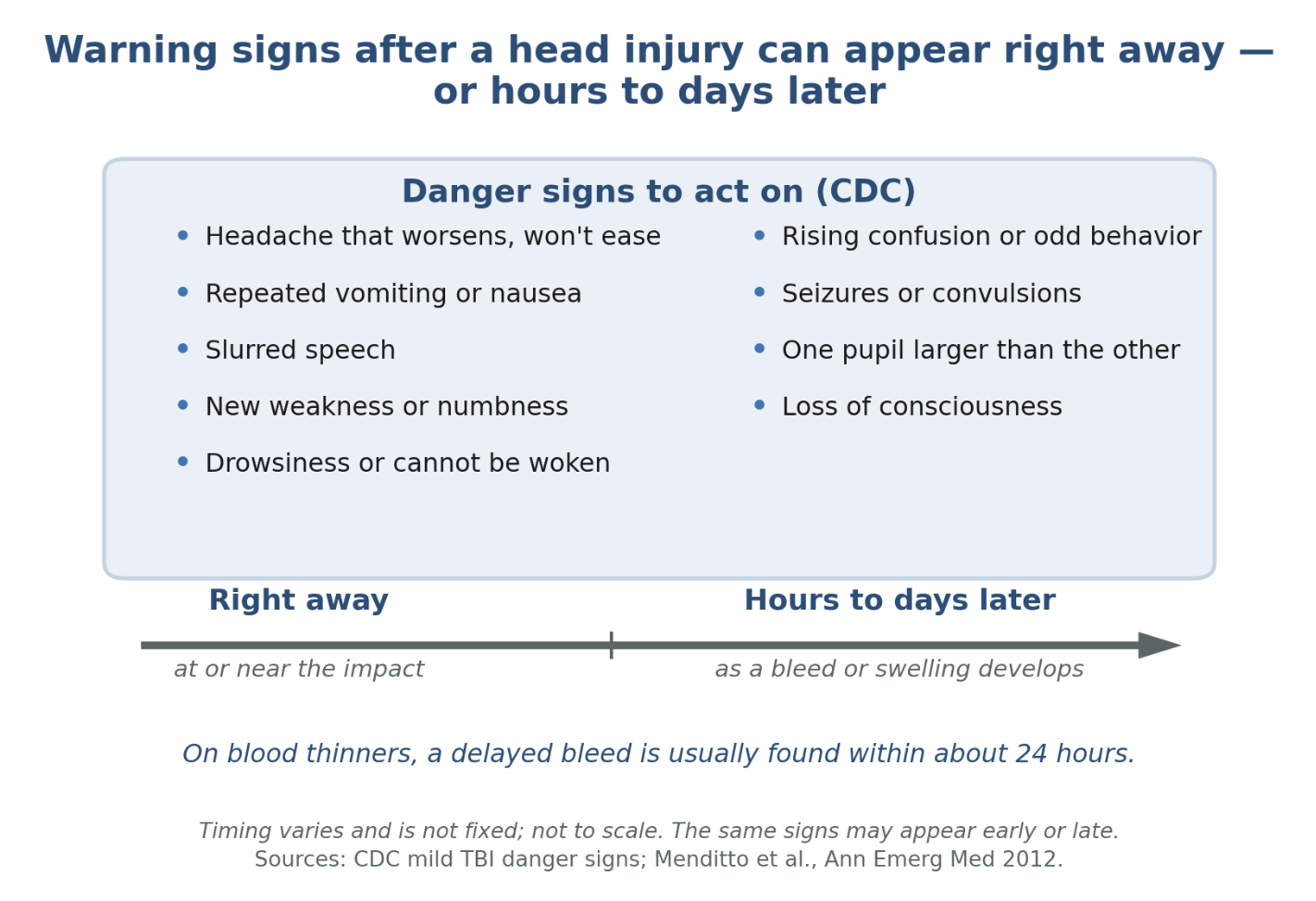
Figure 2. Warning signs after a head injury can appear right away or be delayed by hours to days; on blood thinners a delayed bleed is usually found within about 24 hours. Sources: CDC mild TBI danger signs; Menditto et al. (2012).
Blood thinners call for extra caution, though the evidence is more mixed than once assumed. Recent large analyses have not found anticoagulants such as warfarin (Coumadin) and apixaban (Eliquis) to clearly raise the risk of bleeding inside the skull after a fall,?,¹° while some comparative studies suggest antiplatelet medicines such as aspirin may carry relatively more risk.¹¹ What has not changed is that a bleed can be delayed, surfacing hours after the fall.² Major emergency-medicine guidelines treat blood-thinner use as a reason to evaluate an older adult after any head impact.¹² The same caution applies to anyone who cannot clearly report how they feel.
Over the 24 to 48 hours after a head impact, watch for and seek care if you notice:12
- A headache that worsens rather than eases.
- Increasing drowsiness, or trouble waking the person.
- New confusion, disorientation, or memory gaps.
- Repeated vomiting, dizziness, or loss of balance.
- Changes in mood, behavior, or personality.
- Unequal pupils, new one-sided weakness, or slurred speech. These are emergencies: call 911 right away.
None of this means a fall with a head bump always ends badly. Most do not. It means the safe move is a prompt check and a watchful next few days, so that the rare serious brain bleed is caught while it is still treatable.
Broken bones that hide in plain sight
Not every fracture announces itself with obvious deformity. Some of the most consequential breaks after a fall are the ones a person can partly work around, which is exactly what delays care.
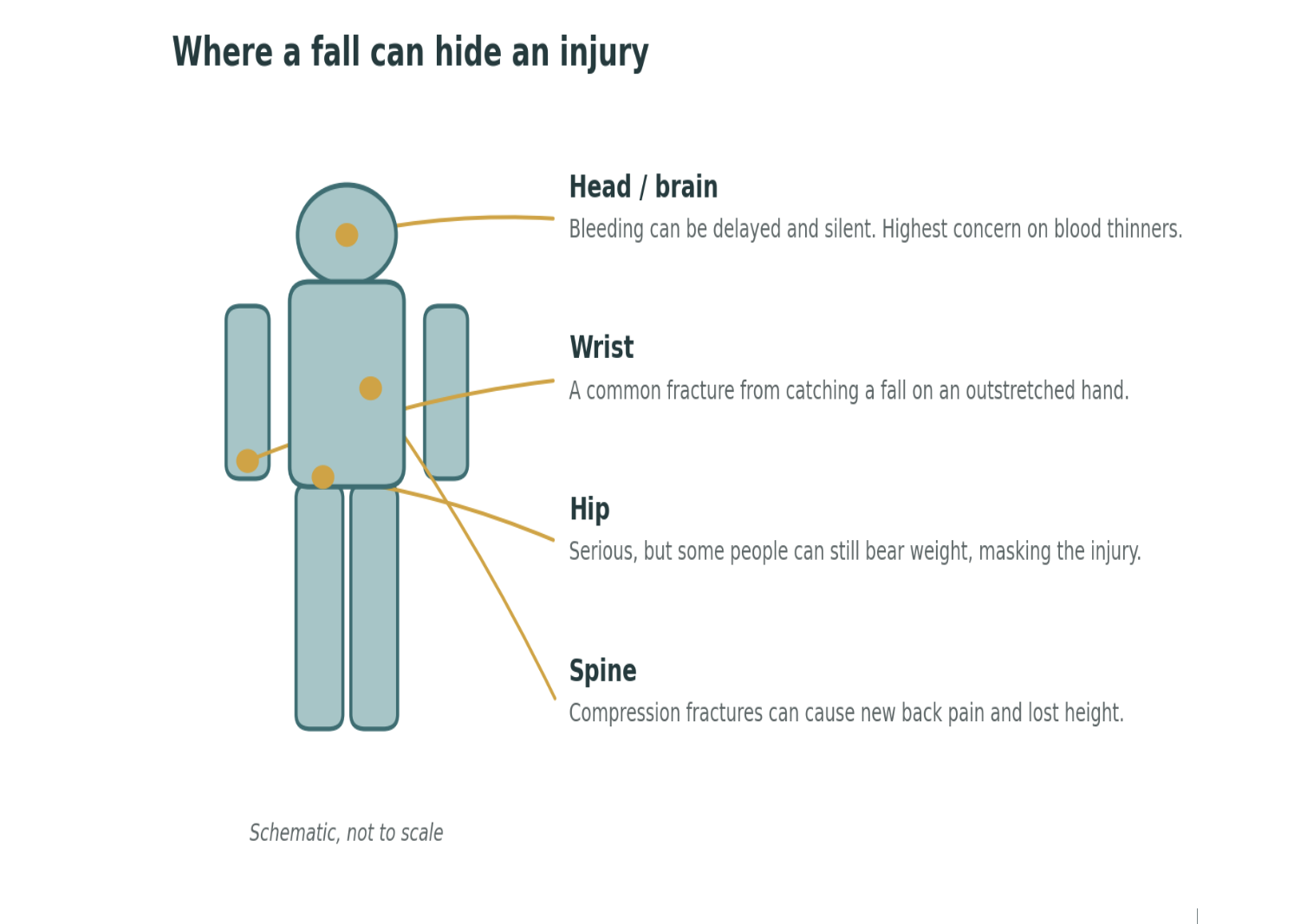
Figure 3. Common and easily missed injury sites after a fall. Schematic, not to scale. Injury patterns per Haddad et al. (2020) and Moreland et al. (2023).
The hip is the clearest example. Hip fractures are serious, and falls cause the overwhelming majority of them in older adults,13 yet a partial or impacted fracture, where the broken ends of the bone stay jammed together, can leave someone still able to stand or take a few painful steps. New pain in the hip, groin, or thigh after a fall, a leg that looks shortened or turned outward, or a sudden reluctance to put weight on one side all deserve same-day evaluation, even if the person is walking. Wrist fractures are common too, because people instinctively catch a fall on an outstretched hand.14,15 And the spine can sustain a compression fracture that shows up only as new back pain or a subtle loss of height over the following weeks. When pain limits how someone moves a day after a fall, that is a signal to have it looked at rather than waited out.
Was it a trip, or did they pass out?
One question changes how seriously to treat a fall: did the person trip over something, or did their body give out first? A fall that follows a faint, a dizzy spell, or a blackout points to a cause beyond a loose rug, such as a drop in blood pressure, an irregular heartbeat, dehydration, or a medication effect. These causes can bring on the next fall without warning, so they need a medical workup to help prevent that next fall from happening.
Helpful details to notice and report include whether the person remembers the fall, whether they felt lightheaded, sweaty, or had a racing heart beforehand, whether they fell on standing up quickly, and whether anyone saw them lose consciousness. A fall with no clear trip or stumble behind it, or one that no one witnessed, should prompt a conversation with a doctor, even when no injury results, because the fall may be a symptom rather than an accident.
When someone falls alone: the symptoms of a long time down
For a person who lives alone, the most dangerous part of a fall is sometimes the time spent on the floor afterward, unable to get up or reach a phone. Researchers call this a “long lie.” 6 There is no single agreed cutoff defining a long lie, but many studies count an hour or more on the floor, 16 and a long lie carries its own set of risks separate from the fall itself. In a study following people in advanced old age, an inability to get up was common and predicted worse outcomes, including injury in a later fall, hospital admission, and higher mortality.17 This is exactly the gap that a medical alert system with automatic fall detection is designed to close, summoning help when a person cannot reach a phone or press a button.
If you find someone who has been down for a long stretch, treat it as a medical event even if the fall looked minor. Watch for cold or clammy skin and shivering, confusion, very dark urine or little urination, intense thirst, and skin that is reddened or broken over pressure points like the hip, heel, or shoulder. Prolonged time on the floor can lead to dehydration, dangerously low body temperature, muscle breakdown that strains the kidneys, and pressure injuries. When in doubt after a long lie, get the person evaluated promptly rather than simply helping them to a chair and moving on. A Digital Health & Care Scotland video on what to do if someone falls is a useful guide for that moment.
Expert Perspective: Reducing the Risk of a Long Lie
“It’s understandable to worry about being stuck lying a long time on the ground if you fall and are unable to get up because, even if you’re not injured, if you can’t call for help or have to wait ages for help to arrive, some potentially serious problems can develop, such as hypothermia, dehydration, muscle and tissue damage from pressure injuries and of course the psychological effects. But learning how to get up off the floor – and keeping practising getting down and back up again – can reduce the fear of falling and ‘long lies’, and exercises to improve strength and balance help to reduce the chances of falling.”
— Jane Fleming, PhD, Assistant Research Professor, Cambridge Public Health, University of Cambridge
Learning to get up from the floor is itself a skill that can be practiced. NHS Inform’s step-by-step guide to getting up safely after a fall shows how, along with how to call for help and keep warm if getting up is not possible.
Expert Perspective: Relearning How to Get Up
“The floor-rise skill can be re-learned quickly. In our feasibility study,18 all participants who completed the floor-rise training programme were able to get up from the floor following the intervention, whereas no improvement was seen in the control group. This was achieved in just five 20-minute sessions.”
— Shane Seeley, DPT, lead author of the Glasgow Caledonian University floor-rise training study; Senior Physiotherapist, Sussex Community NHS Foundation Trust
There is also a human side to a long lie. Dr. Seeley points to it:
Expert Perspective: Calling for Help in Time
“Families may underestimate both the seriousness of prolonged time spent on the floor and the importance of responding quickly. Some people do not activate their personal alarm, and family members may not appreciate the potential consequences of remaining on the floor for several hours. I often hear ‘I did not want to bother the ambulance service’ from patients and family members explaining why they did not escalate at the early stages of a long lie. For people at higher risk of falls, particularly those living alone, personal alarm systems and plans for summoning help can be valuable. Equally important is helping older adults develop the confidence and skills to get up independently where appropriate.”
— Shane Seeley, DPT, Senior Physiotherapist, Urgent Community Response, Sussex Community NHS Foundation Trust
The symptoms with no X-ray
Some of the most important changes after a fall are behavioral. In the days following a fall, watch for a person who suddenly stops doing things they enjoyed, who grips furniture and walls, or who seems newly anxious about walking. A fear of falling is a normal response, but when it tips into avoidance, it can start a cycle: less activity leads to weaker muscles and poorer balance, which raises the risk of the next fall.19,21 Naming that pattern early, and encouraging safe movement rather than retreat, helps keep caution from quietly shrinking a person’s world.
New or fluctuating confusion deserves particular attention. In older adults, a sudden change in alertness or thinking after a fall can signal delirium, an infection, a medication problem, or the delayed head bleed described earlier. Confusion that arrives in the hours or days after a fall is not something to attribute to age. It is a symptom, and it warrants a call to a clinician.
A simple framework you can keep on the fridge
Faced with a real fall, most families do not need a long list. They need a way to decide quickly. The three tiers in Figure 1 give that structure: call 911 for the emergency signs, including stroke-like changes such as face droop, one-sided weakness, or slurred speech, where minutes matter for treatment; arrange same-day care for a head impact, a possible faint, or pain that limits movement; and watch closely for 24 to 48 hours when nothing obvious is wrong. The one rule that ties it together is to round up when unsure. When in doubt, call 911. When symptoms are unclear or potentially serious, it is safer to seek medical evaluation than to risk missing a brain bleed or fracture.
How fast help closes the dangerous gap
Recognizing symptoms only helps if someone is there to act on them, and the research on long lies shows how much the speed of help matters.171 The faster a fall is answered, the smaller the chance that a minor event turns into dehydration, a long time cold on the floor, or a delayed trip to care. Speed is its own form of protection.
This is the role a medical alert system plays. A wearable help button lets a person who has fallen reach a trained responder in seconds, rather than waiting and hoping someone checks in. You can see how that connection works, from the press of a button to a real person on the line, in our guide to how medical alert systems work.
For the situation families worry about most, when a fall leaves someone unable to press a button, automatic fall detection can summon help on its own, both away from home and in the rooms where many falls happen, such as with a home-based system. If you are weighing options, our buying guide walks through how to match a device to a person’s routine. The point is not the hardware. It is closing the gap between a fall and the help that follows, so that a quiet symptom is never left to grow unnoticed.
For caregivers: watching closely without hovering
If you are caring for an aging parent or partner, the days after a fall ask a lot of you: stay alert to symptoms without making the person feel watched or fragile. A few specific habits make that easier. Agree in advance on what counts as a reason to call you, so your loved one feels like a partner in the plan rather than a patient under surveillance. After any head impact, check in over the next few days and look for the delayed signs above. If they live alone, set up a reliable way to know the moment something needs your attention, so you can stay informed from anywhere without calling every hour.
The aim is to give your loved one more room to stay active safely, not less. You will know if a fall happens or a symptom appears, and they keep the daily independence that keeps them strong. That balance, visibility for you and freedom for them, is the version of help that actually lasts.
Frequently Asked Questions
What symptoms should you watch for after an older person falls?
Watch for anything pointing to a head injury or a serious fracture: a worsening headache, drowsiness, new confusion, repeated vomiting, slurred speech, weakness, or pain that limits walking or use of a limb. Some signs, especially from a head injury, can be delayed by hours, so keep watching for 24 to 48 hours even if the person seems fine at first. When in doubt, call 911.
What should you do right after a fall, especially if the head was hit?
First, check for danger signs before moving the person. Call 911 for loss of consciousness, a severe or worsening headache, repeated vomiting, slurred speech, new weakness, a seizure, or a deformed limb. If none of those are present and the person can move without sharp pain, help them up slowly, then watch closely over the next day or two. After any blow to the head, seek prompt medical advice, and take extra care if they take a blood thinner.
Should you go to the hospital after hitting your head in a fall?
Seek prompt medical care after any head impact, and call 911 for loss of consciousness, a severe or worsening headache, repeated vomiting, slurred speech, or new weakness. Anyone taking blood thinners should be checked promptly, even if they seem fine at first.
How long after a fall can a brain bleed show up?
Symptoms of bleeding inside the skull can appear hours or even a day or two after the impact, not just immediately. Extra caution applies to people on blood thinners (such as warfarin, apixaban, or aspirin), who should be evaluated promptly after any head impact.
What are delayed symptoms after a fall?
Some of the most important symptoms do not appear at the scene. A brain bleed can take hours, or even a day or two, to cause a worsening headache, drowsiness, confusion, or repeated vomiting. Pain from a hairline fracture or a strained back can build over the following day. New confusion, balance problems, or a reluctance to move also tend to surface later. This is why watching closely for 24 to 48 hours matters even when the person seems fine at first.
How long should you watch someone after a fall?
Plan to watch closely for the first 24 to 48 hours, when delayed problems such as a slow brain bleed are most likely to declare themselves. Check in regularly, make sure the person can be woken easily, and look for a worsening headache, new confusion, drowsiness, repeated vomiting, or trouble walking. If anything new appears, get it checked, and call 911 for the emergency signs.
How long after a fall can pain start?
Pain can be delayed. The surge of adrenaline around a fall can mask injury, and pain from a fracture, a strained muscle, or a compression fracture in the spine often builds over the next one to three days as swelling sets in. New or worsening pain a day or two after a fall, especially pain that limits walking or use of a limb, is a reason to have it looked at rather than waited out.
Can you have a hip fracture and still walk?
Yes. A partial or impacted hip fracture can leave a person able to stand or take a few painful steps, which is why it is sometimes missed. New hip, groin, or thigh pain after a fall, a leg that looks turned out or shortened, or reluctance to bear weight all warrant same-day evaluation even if the person is walking.
What is a “long lie” after a fall, and why does it matter?
A long lie is when someone is unable to get up and remains on the floor for an extended period. There is no single agreed cutoff, but many studies count an hour or more. It is linked to dehydration, low body temperature, muscle breakdown, pressure injuries, and worse outcomes overall, so it should be treated as its own medical event even if the fall seemed minor.
Why is my parent confused after a fall?
New or fluctuating confusion after a fall is a warning sign, not a normal part of aging. It can signal a head injury, delirium, an infection, or a medication problem, and it warrants a prompt call to a clinician, or 911 if it comes on suddenly or with other warning signs.
References
- Facts About Falls | Older Adult Fall Prevention | CDC. https://www.cdc.gov/falls/data-research/facts-stats/index.html.
- Mann, N. et al. Delayed intracranial hemorrhage in elderly anticoagulated patients sustaining a minor fall. BMC Emergency Medicine 2018 18:1 18, 27- (2018).
- Haj-Mirzaian, A. et al. Use of Advanced Imaging for Radiographically Occult Hip Fracture in Elderly Patients: A Systematic Review and Meta-Analysis. Radiology 296, 521–531 (2020).
- Singh, R., Yadav, H. S., Mishra, A. R. & Gupta, S. Delayed diagnosis of femoral neck fracture: A case report and literature review. Int. J. Surg. Case Rep. 136, 111979 (2025).
- Jaqua, E. E., Nguyen, V. T. N. & Chin, E. Delirium in Older Persons: Prevention, Evaluation, and Management. Am. Fam. Physician 108, 278–287 (2023).
- Kubitza, J., Haas, M., Keppeler, L. & Reuschenbach, B. Therapy options for those affected by a long lie after a fall: a scoping review. BMC Geriatr. 22, 582 (2022).
- Peterson, A. B., Zhou, H., Thomas, K. E. & Daugherty, J. Traumatic Brain Injury-Related Hospitalizations and Deaths by Age Group, Sex, and Mechanism of Injury: United States 2016/2017. Preprint at http://stacks.cdc.gov/view/cdc/111900 (2021).
- Menditto, V. G., Lucci, M., Polonara, S., Pomponio, G. & Gabrielli, A. Management of minor head injury in patients receiving oral anticoagulant therapy: A prospective study of a 24-hour observation protocol. Ann. Emerg. Med. 59, 451–455 (2012).
- de Wit, K. et al. Clinical Predictors of Intracranial Bleeding in Older Adults Who Have Fallen: A Cohort Study. J. Am. Geriatr. Soc. 68, 970–976 (2020).
- Dubucs, X. et al. Risk Factors for Traumatic Intracranial Hemorrhage in Older Adults Sustaining a Head Injury in Ground-Level Falls: A Systematic Review and Meta-analysis. Ann. Emerg. Med. 87, 181–191 (2026).
- Vedin, T. et al. Antiplatelet therapy contributes to a higher risk of traumatic intracranial hemorrhage compared to anticoagulation therapy in ground-level falls: a single-center retrospective study. Eur. J. Trauma Emerg. Surg. 48, 4909–4917 (2022).
- Valente, J. H. et al. Clinical Policy: Critical Issues in the Management of Adult Patients Presenting to the Emergency Department With Mild Traumatic Brain Injury: Approved by ACEP Board of Directors, February 1, 2023 Clinical Policy Endorsed by the Emergency Nurses Associati…. Ann. Emerg. Med. 81, e63–e105 (2023).
- Moreland, B. L., Legha, J. K., Thomas, K. E. & Burns, E. R. Hip Fracture-Related Emergency Department Visits, Hospitalizations and Deaths by Mechanism of Injury among Adults Aged 65 and Older, United States 2019. J. Aging Health 35, 345–355 (2023).
- Hsu, H., Fahrenkopf, M. P. & Nallamothu, S. V. Wrist Fracture. Differential Diagnosis of Fracture 155–209 (2023) doi:10.1007/978-981-13-8339-7_4.
- Mauck, B. M. & Swigler, C. W. Evidence-Based Review of Distal Radius Fractures. Orthopedic Clinics of North America 49, 211–222 (2018).
- Kubitza, J., Schneider, I. T. & Reuschenbach, B. Concept of the term long lie: a scoping review. Eur. Rev. Aging Phys. Act. 20, (2023).
- Fleming, J. & Brayne, C. Inability to get up after falling, subsequent time on floor, and summoning help: prospective cohort study in people over 90. BMJ 337, 1279–1282 (2008).
- Seeley, S. C., Skelton, D. A., Tan, C. W., Stansfield, B. & Dall, P. M. Comparing the impact of active floor-rise training with video demonstration on fear of falling and independent floor-rise ability in older adults living in the community: a pilot cluster randomised controlled trial. Age Ageing 55, (2026).
- Deshpande, N. et al. Activity restriction induced by fear of falling and objective and subjective measures of physical function: A prospective cohort study. J. Am. Geriatr. Soc. 56, 615–620 (2008).
- Bhorade, A. M. et al. Rate of Falls, Fear of Falling, and Avoidance of Activities At-Risk for Falls in Older Adults With Glaucoma. Am. J. Ophthalmol. 227, 275–283 (2021).
- Zijlstra, G. A. R. et al. Effects of a multicomponent cognitive behavioral group intervention on fear of falling and activity avoidance in community-dwelling older adults: Results of a randomized controlled trial. J. Am. Geriatr. Soc. 57, 2020–2028 (2009).

Dr. Eliezer (Eli) Lichter
Dr. Eliezer (Eli) Lichter brings a rare combination of hands-on clinical experience and rigorous scientific training to his work as a medical writer at Medical Guardian.
Before entering research, Eli served as an emergency medical technician in Yonkers, New York, one of the state’s busiest urban EMS systems, where he was recognized with multiple Lifesaving Citation Awards. That work put him on the front lines of exactly the crises Medical Guardian exists to prevent, including fall responses involving older adults. He later served in an administrative role at a large skilled nursing facility in upstate New York, where he managed the full operational complexity of senior care, including fall prevention protocols and incident response.
That direct, real-world exposure to what aging adults and their families face every day shapes everything he writes.
Eli earned his PhD in Biochemistry and Molecular Biology from the University of Nebraska Medical Center, where his research focused on the genetic mechanisms underlying neurodegenerative diseases, including Alzheimer’s and Parkinson’s disease. He then completed postdoctoral training at Boston University in computational biomedicine, including a research affiliation with the Broad Institute of MIT and Harvard, developing molecular and computational strategies for early detection of cancer, Alzheimer’s disease, and other serious conditions through advanced applications in genomics and epigenetics.
At Medical Guardian, Eli translates complex medical and scientific research into clear, trustworthy content that helps older adults and their families make informed decisions about their health, safety, and independence.