Quick Summary
Caregiver burnout is the physical, emotional, and mental exhaustion that builds up when you care for an aging parent, spouse, or friend without enough rest or support. It is common: across 18 meta-analyses, roughly a third of family caregivers screen positive for depression, a third for anxiety, and about half report meaningful caregiving burden.1 The encouraging part is that burnout responds to action. Learning the warning signs, taking the short self-check in this article, and using a few evidence-based strategies all help. Together they protect your own health while you keep showing up for the person who depends on you.
Medical Disclaimer: This article is for general education and is not a substitute for professional medical or mental-health advice. Caregiver burnout can overlap with depression, anxiety, and other conditions that deserve individual care. If you are concerned about your physical or emotional health, please talk with a licensed clinician who knows your situation.
On this page:
- What is caregiver burnout?
- How common is it?
- Signs and symptoms
- Causes and risk factors
- Self-assessment quiz
- Why it matters for your health
- How to recover
- When to seek help
- FAQ
What Is Caregiver Burnout?
Caregiver burnout is a state of physical, emotional, and mental exhaustion that develops when the demands of caring for someone outpace the time, energy, and support a caregiver has to meet them. The term borrows from research on workplace burnout. That work describes three linked experiences: deep exhaustion, growing detachment or cynicism, and a shrinking sense of being effective at what you do.2 In a caregiving context, that can look like running on empty, feeling numb or short-tempered toward the person you love, and quietly wondering whether anything you do is making a difference.
It helps to know where the word comes from. The World Health Organization added burnout to its International Classification of Diseases (ICD-11) in 2019, yet defined it narrowly as an occupational phenomenon tied to chronic workplace stress, and noted that the term should not be applied to other areas of life.3 At the time, the WHO was careful to say that burnout is not classified as a medical condition, and it announced plans to develop evidence-based guidelines on mental well-being in the workplace. That framing still stands in the current ICD-11, which took effect in January 2022. Family caregiving is rarely a paid job, yet it is a job, and a difficult one at that. Caregiver burnout therefore falls outside that formal definition only on a technicality. The label is still useful, because what caregivers describe maps closely onto the same three dimensions. The point is practical, not academic: what you are feeling is real and recognized, even if it does not fit neatly into a billing code.
Is caregiver burnout the same as depression or ordinary stress?
Not exactly, and the difference matters. Everyday caregiving stress tends to rise and fall with the day, and it eases when you rest. Burnout is what happens when that stress goes unrelieved for long enough that rest alone no longer resets you.2 Depression and burnout overlap enough that researchers still debate where one ends and the other begins. Studies that compare the two head-to-head do find consistent differences, though. Burnout tends to stay tied to the source of the strain, felt as exhaustion and a growing detachment or cynicism toward the role that is wearing you down. Depression reaches further. It more often spreads beyond any single part of life, bringing a low mood that will not lift, a loss of pleasure in things once enjoyed, trouble getting started on ordinary tasks, and a harsh sense of low self-worth.4,5 These three (everyday stress, burnout, and depression) often overlap, which is one reason clinicians screen for all three rather than assuming a single cause. If low mood, hopelessness, or thoughts of self-harm are present, that signals that something needs attention, whether that turns out to be burnout, depression, or ordinary strain. Either way, it is a reason to reach out for help rather than push harder.
How Common Is Caregiver Burnout?
In its Caregiving in the U.S. 2025 report, the AARP and the National Alliance for Caregiving found that about 63 million adults, nearly one in four, provided ongoing care to an adult or child in the previous year. Of these, 94 percent, roughly 59 million, were caring for an adult.6 Caregiving on that scale takes a measurable toll. In the same survey, about one in five caregivers rated their own health as fair or poor. Nearly one in four said it was hard to take care of their own health. About two-thirds of caregivers (64 percent) report moderate to high emotional stress from caregiving.6
You may have seen a widely repeated figure that more than 60 percent of caregivers experience burnout. It makes for a memorable headline, but it is difficult to trace to a single peer-reviewed source, so it is best treated as a rough signal rather than a precise rate. The peer-reviewed picture is both more precise and more useful. A 2025 umbrella review pooled 18 meta-analyses of family caregivers worldwide and found median prevalence rates of about 33 percent for depression, 35 percent for anxiety, and 49 percent for caregiving burden,1 here meaning the multidimensional, self-perceived strain of caregiving that spans physical, emotional, social, and financial life and builds over time7 (Figure 1). Notably, that same review could not calculate pooled rates for stress or burnout specifically, because too few of the underlying meta-analyses measured them, which is part of why a single trustworthy burnout percentage is so hard to pin down.1 However you count it, distress among caregivers is common enough that feeling it does not mean you are doing anything wrong.

Figure 1. Median pooled prevalence of depression (33.35%), anxiety (35.25%), and caregiving burden (49.26%) across 18 meta-analyses of informal caregivers. Pooled rates for stress and burnout were not calculable in the review. Source: Soh et al., 2025.
What Are the Signs and Symptoms of Caregiver Burnout?
Burnout rarely announces itself. It accumulates, which is why naming the signs early is one of the most protective things a caregiver can do. The symptoms tend to cluster in three areas.8,9
Physical signs: ongoing fatigue that sleep does not fix, frequent headaches or muscle tension, changes in appetite or weight, trouble sleeping even when exhausted, and getting sick more often than usual.
Emotional signs: irritability or anger that surprises you, anxiety, sadness or tearfulness, feeling numb or detached from the person you care for, and a creeping sense of hopelessness or resentment.
Behavioral signs: pulling away from friends and activities you used to enjoy, neglecting your own appointments and needs, leaning more on caffeine or alcohol to cope, and finding you have less and less patience for tasks that once felt manageable.
What are the stages of caregiver burnout?
Burnout tends to move along a rough arc rather than appearing overnight. Many caregivers first push through with determination, telling themselves the strain is temporary. Over time, unrelieved stress hardens into chronic exhaustion, then into emotional distancing and self-doubt about whether their effort matters. Left unaddressed, it can tip into the physical and mental-health consequences described later in this article. The arc is not inevitable. Each stage is a point where support, rest, or a change in the care plan can turn things around.
Expert Perspective: How Burnout Builds Over the Caregiving Career
“In the early stages of the caregiving journey when caregiving demands are relatively light, caregivers typically cope quite well. For many chronic health conditions disability levels increase and associated care demands become increasingly stressful. In the mid to late stages of a caregiving career when disability levels and caregiving demands are high caregivers experience burnout and high levels of distress.”
— Richard Schulz, PhD, Distinguished Service Professor of Psychiatry, Emeritus, School of Medicine, University of Pittsburgh; Director Emeritus, University Center for Social and Urban Research
What Causes Caregiver Burnout, and Who Is Most at Risk?
Burnout is driven by the gap between demands and resources,9 not by weakness or by loving someone too little. Several factors widen that gap.
Intensity and duration. Nearly one in four caregivers provide 40 or more hours of care a week, the equivalent of a second full-time job.6 The heavier and longer the load, the higher the risk.
Caring for someone with dementia. Dementia caregiving is recognized as especially demanding, because it adds memory loss, behavioral changes, and around-the-clock supervision to the physical work of care. A large share of family caregivers assist someone with Alzheimer’s disease or another dementia, and research on these caregivers describes care that is extremely stressful and that raises the risk of mental-health and physical illness, and even death, among caregivers themselves.10,11
Being a spouse or partner. Spouse caregiver burnout deserves its own mention. Older spouses often provide intense, hands-on care while managing their own health conditions, and they are less likely to ask for outside help. For this group, unrelieved strain carries a measurably higher risk of serious health problems, including earlier death, a risk tied to the strain itself rather than to caregiving alone.11–13 Strain, not caregiving by itself, is the warning sign. The section on your health below looks at this evidence, and the numbers behind it, in detail.
Isolation and lack of relief. Caregivers without backup, respite, or social support carry more of the load alone, and isolation is one of the most consistent predictors of distress.
Financial and role strain. Lost income, out-of-pocket costs, and juggling care with a job or young children all compound the pressure. The scale of this is easy to underestimate. In the 2025 national survey, nearly half of family caregivers reported at least one major financial impact from caregiving, defined as taking on debt, stopping their savings, or being unable to afford food. Role strain compounds the money worry: nearly one in three caregivers is also raising a child under 18 at the same time, the so-called sandwich generation. The name captures the double squeeze of caring for an older loved one while raising children, pressed between the needs of two generations. That share climbs to 47 percent among caregivers under 50, and is much lower among older caregivers, which is why the overall figure lands near one in three. These pressures matter for burnout in a specific way. Beyond the stress they create in the moment, they quietly shrink the options a caregiver has for respite, backup, and time off. That is what turns ordinary financial worry into a driver of exhaustion rather than a side effect of it.6
Caregiver Burnout Self-Assessment Quiz
The most trustworthy way to gauge your own risk is a validated, published self-assessment rather than an informal quiz. A widely used option is the Modified Caregiver Strain Index, a 13-item screening tool developed and validated in the peer-reviewed literature.14 It asks about the physical, financial, social, emotional, and personal pressures of caregiving, and it takes about five minutes to complete.
Each item is answered on a simple three-point scale, a regular yes, an occasional yes, or a no, for a total score from 0 to 26. Higher scores indicate greater strain. Its developers did not set an official cutoff, so the number is best read as a continuum rather than a pass-or-fail line: the higher it climbs, the more worth taking seriously. You can take it for free through the Hartford Institute for Geriatric Nursing, which publishes the tool with permission to reproduce it for educational use.
If you would rather start with a quick gut-check, a few honest questions can be revealing. Over the past two weeks, has sleep or rest stopped leaving you recovered? Do you feel emotionally distant or numb toward the person you care for? Have you pulled back from friends, hobbies, or your own medical appointments? Are you leaning more on caffeine, alcohol, or food to get through the day? None of these is a diagnosis, but several yes answers are a sign that it is time to add support, and, if low mood or hopelessness is present, to talk with a clinician.

Figure 2. Scoring scale for the Modified Caregiver Strain Index (0 to 26); higher scores indicate greater strain. The tool has no official cutoff. Source: Thornton and Travis, 2003. An educational screening tool, not a diagnosis.
How to use this self-check
A self-check is a mirror, not a verdict. Scores shift as circumstances change. If your number is higher than you expected, that is information you can act on, not a failing.
Why Caregiver Burnout Matters for Your Health
Caregiver strain is not only uncomfortable. It can shorten life. In the Caregiver Health Effects Study, older spouses who provided care and felt strained were 63 percent more likely to die over the following four years than similar adults who were not caregiving. That gap held even after accounting for existing illness and other factors.11–13 Caregivers who did not report strain showed no such increase, which underscores a hopeful point: the danger lies in unrelieved strain, and strain is something support can change (Figure 3). Reducing the burden is not a luxury. It is part of staying healthy enough to keep caring.
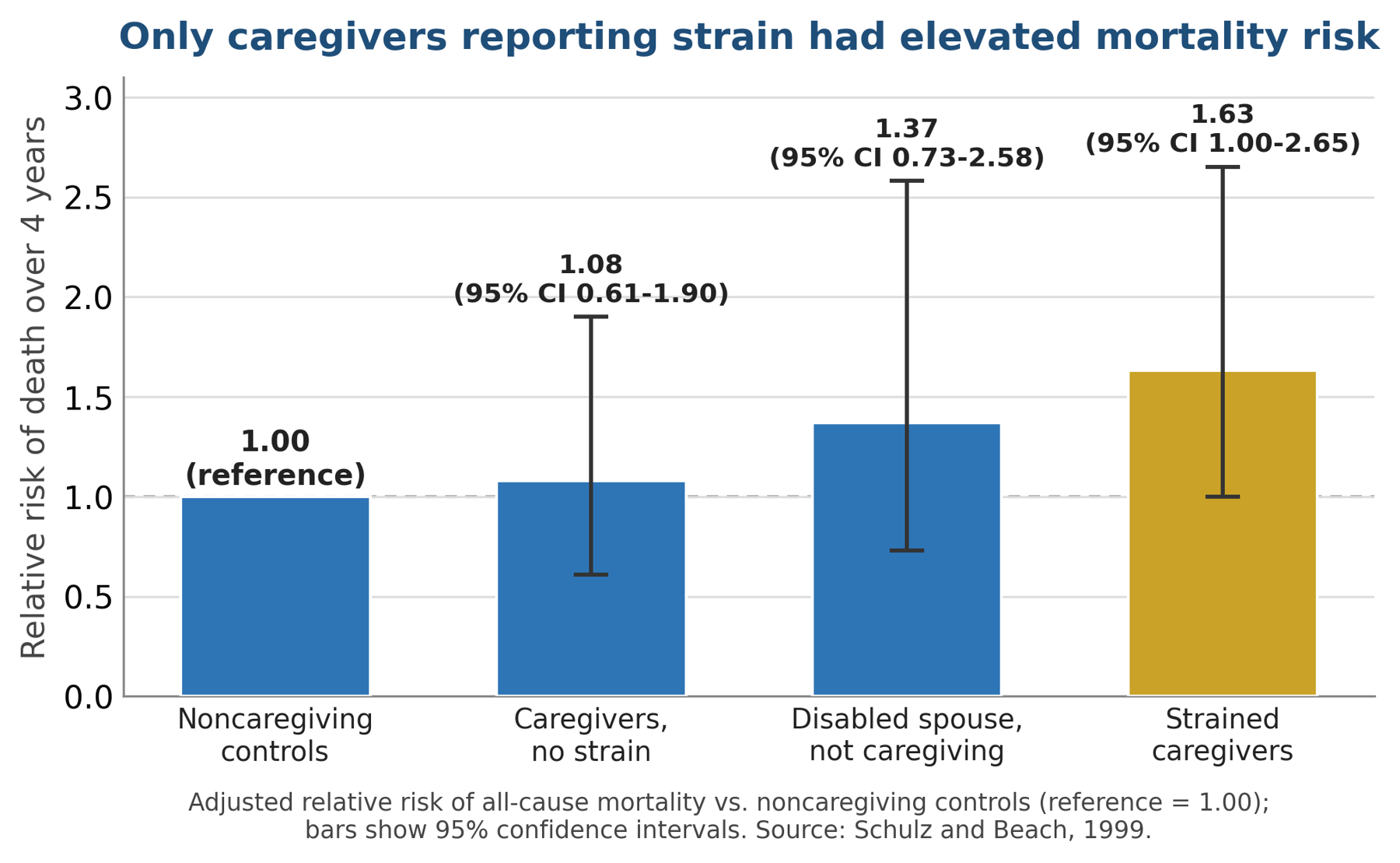
Figure 3. Four-year relative risk of death versus noncaregiving controls (reference 1.00). Only strained caregivers showed elevated risk (1.63; 95% CI 1.00 to 2.65); caregivers without strain (1.08) and non-caregiving spouses of a disabled partner (1.37) did not. Error bars show 95% confidence intervals. Source: Schulz & Beach, 1999.
Expert Perspective: Keeping the Mortality Risk in Perspective
“The effects of caregiving on mortality are sometimes exaggerated in the literature. They apply to older, frail, long term, spousal caregivers.”
— Richard Schulz, PhD, Distinguished Service Professor of Psychiatry, Emeritus, School of Medicine, University of Pittsburgh; Director Emeritus, University Center for Social and Urban Research
How Do You Recover From Caregiver Burnout?
Burnout responds to action, and you do not have to overhaul your life to feel the difference. Decades of research point to a handful of approaches that reliably help.
Expert Perspective: Two Coping Skills to Start With
“A key coping skill is learning to PAUSE – take a ‘time-out’ – before responding when something happens that upsets you. When you pause, use the opportunity to take slow, deep breaths – inhaling slowly, pausing, exhaling very slowly, for 5 or more ‘rounds’ – this gives our nervous system a chance to relax and refresh. Then you can go back to the challenging situation and you’ll find you can cope with it with less stress.
The second skill that really makes a difference is planning to do small, manageable positive activities every single day – either on your own (like talking to a friend, making a favorite cup of coffee or tea, or going outside & doing a short walk) OR doing them with your care recipient (like looking at photo albums or favorite tv shows together). I can’t stress enough how important this is! By doing this regularly, you are creating a ‘buffer’ so that when challenges come along, you’ll be better able to handle them in more positive ways.”
— Dolores Gallagher Thompson, PhD, ABPP, Board Certified in Clinical Psychology and Geropsychology, American Board of Professional Psychology; Professor of Research (Emerita, Active), Department of Psychiatry and Behavioral Sciences, Stanford University School of Medicine
Build in real breaks (respite)
Time away is the most direct answer to the always-on-call feeling. That can mean a few hours from a family member, an adult day program, or in-home respite. Even short, regular breaks ease the sense that the care never stops.
If leaving feels impossible, whether because of cost, distance, or a care recipient who resists anyone else stepping in, more help usually exists than it first appears. A good first call is your local Area Agency on Aging, reachable through the Eldercare Locator or at 1-800-677-1116. These agencies can point you to sliding-scale or no-cost respite, adult day programs, and in-home aide hours. Many states also fund respite through Medicaid home and community-based services waivers or a Lifespan Respite program, and the ARCH National Respite Locator lists options state by state, including voucher programs for families who qualify. For everyday needs like meals, transportation, or short-term help, dialing 211 connects you to local services at no charge. Volunteer and faith-based respite, where a trained visitor sits with your family member for a few hours, is often free and can be arranged through a congregation, a senior center, or the Caregiver Action Network Family Caregiver Help Desk at 1-855-227-3640. One more practical note: if a care recipient resists outside help, introduce a helper for a single short, predictable task. Framing it that way, rather than as a break for you, tends to lower resistance over time.
Learn the skills, not only the facts
Programs that teach practical coping skills, not only information, have the strongest track record. A meta-analysis of 78 caregiver intervention studies found that psychoeducational and psychotherapeutic approaches produced the most consistent improvements across burden, depression, and well-being.15 The multi-site REACH II trial, which combined education, skills training, and support for caregivers of people with dementia, improved quality of life and lowered rates of clinical depression compared with usual care.10 Later trials that adapted REACH for other settings reduced caregiver burden as well.16 Cognitive behavioral techniques, which help you notice and reframe the thoughts that fuel guilt and overwhelm, are a core part of these programs. The largest of these reviews is now more than twenty years old, and its trials enrolled mostly white caregivers, so it reads best as a foundation rather than the last word. Its lead author, Silvia Sörensen, notes that which approach helps most is likely more nuanced than the early evidence could capture, and researchers are now testing whether specific programs suit specific groups of caregivers.
Expert Perspective: Three Kinds of Support to Seek Out
“For a caregiver who cannot enroll in a formal program, I think there are three elements they should try to seek out:
1. Emotional Support – a person, a group, or an online connection that will provide them with validation of their worth, tell them they are doing the best they can when they have self-doubt, and listen to them without judgment.
2. Planning and Decision support – Someone to talk them through difficult (and even small) decisions, to help them avoid jumping to conclusions or first-thought solutions, and to help them consider the pros and cons of all possible solutions and avoid ruling out solutions that might be the best for all, even though they might go against initial inclinations (this is what we do with problem-solving training).
3. Knowledge and Skills – gathering as much knowledge as they can about (a) the care recipient’s disease process, (b) disease-related behaviors, (c) emotional needs, (d) medical needs, (e) how to respond to dementia related behaviors that might catch you off guard, (f) how to ask others for help when you are overwhelmed, and (g) Also needed is good information about what kinds of respite care, living situations, and care supports are available in the community.”
— Silvia Sörensen, PhD, Associate Professor and Program Director for Human Development, Warner School of Education and Human Development, University of Rochester
Lean on other people
Connecting with other caregivers, in person or online, counters isolation and surfaces practical workarounds from people who have faced the same situations. Saying the load out loud, to a friend, a group, or a counselor, is itself protective. A few well-established groups make it easy to start: the Family Caregiver Alliance offers fact sheets and a helpline at 1-800-445-8106, the Alzheimer’s Association runs a free 24/7 helpline at 1-800-272-3900 for dementia caregivers, and the Well Spouse Association hosts peer groups specifically for husbands and wives caring for a partner.
Protect your own body
Sleep, movement, and regular meals are not indulgences when you are carrying this much. Guard your own medical appointments, and treat sleep as part of the care plan, because exhaustion magnifies every other stressor.
Let technology carry some of the watching
Part of caregiver strain is the feeling that you must be reachable and watchful every hour. Tools that handle some of that monitoring give back real breathing room. A medical alert system, for example, lets an older adult call for help at the press of a button or after a fall. A caregiver can then step away, knowing help is one touch away rather than staying on call around the clock. Medical Guardian’s on-the-go devices and in-home systems are built around that idea. You can see how medical alert systems work or compare options and pricing to judge whether one fits your situation. The goal is straightforward: less time spent watching, more time spent living.
Ask for, and accept, help
Many caregivers carry the load alone because asking feels like failing. Sharing tasks, with family, paid help, or community programs, is one of the most effective ways to lower strain. A short, specific request, such as “Could you sit with Mom on Tuesday evenings?”, is far easier for someone to say yes to than a general one. Start with one ask this week.
When Should a Caregiver Seek Professional Help?
Self-care and support handle a great deal, but some signs call for a clinician. Reach out to your doctor or a licensed mental-health professional if you notice persistent low mood or hopelessness, loss of interest in nearly everything, sleep or appetite changes that last for weeks, anxiety you cannot quiet, or any thoughts of harming yourself. These can signal depression or an anxiety disorder, which are common among caregivers and very treatable. Asking for help here is not a detour from caregiving. It is how you stay well enough to continue.
If you ever feel you might act on thoughts of self-harm, treat it as the emergency it is and reach out right away to emergency services or a crisis line in your area. In the United States you can call or text 988 for the Suicide and Crisis Lifeline.
Caregiver burnout is common, it is not a personal failing, and it gets better with the right mix of rest, support, and care for yourself. Begin with one change this week, and let it make room for the next.
Frequently Asked Questions
What is caregiver burnout?
Caregiver burnout is the physical, emotional, and mental exhaustion that builds when caregiving demands outpace your time, energy, and support. It often shows up as deep fatigue, irritability, detachment from the person you care for, and a sense that your efforts are not enough. It is a sign to add support, not a sign of failure.
What are the first signs of caregiver burnout?
Early signs include fatigue that rest does not fix, trouble sleeping, irritability, pulling back from friends and hobbies, and skipping your own appointments. Catching these early, with the self-check in this article, gives you the best chance to act before exhaustion deepens.
How is caregiver burnout different from depression?
Burnout is tied to the caregiving role and tends to ease when the load lightens. Depression is broader, affecting all of life, and often brings lasting low mood, loss of interest, or hopelessness. The two overlap, so if low mood or hopelessness lingers, it is worth talking with a clinician.
How common is caregiver burnout?
Very common. Across 18 meta-analyses of family caregivers, about a third screened positive for depression, a third for anxiety, and roughly half reported meaningful caregiving burden; pooled rates for burnout itself could not be calculated. If you feel it, you are far from alone.
What causes caregiver burnout?
It comes from the gap between what caregiving demands and the support you have. Long hours, dementia care, caring for a spouse, isolation, and financial strain all widen that gap. It is about circumstances and resources, not about how much you love the person.
Is spouse caregiver burnout different?
Spouses often give intense, hands-on care while managing their own health, and they ask for help less often. Research shows that older spousal caregivers who feel strained face higher health risks, so building in relief and support matters most for this group.
How do I recover from caregiver burnout?
Start with real breaks, lean on support groups and skills-based programs, protect your sleep and health, and ask for specific help. Cognitive behavioral and psychoeducational programs have the strongest evidence. Small, steady changes add up faster than one big overhaul.
Can a medical alert system help reduce caregiver stress?
It can ease the always-on-call feeling. With a medical alert system, an older adult can call for help at the press of a button or after a fall, so you can step away knowing help is one touch away. You can review how the systems work or explore the Medical Guardian experience to see if one fits your family.
How do I take a caregiver burnout quiz, and what does my score mean?
The self-assessment section above points you to the Modified Caregiver Strain Index, a validated 13-item tool you can take for free through the Hartford Institute for Geriatric Nursing. Each item scores 0, 1, or 2, for a total from 0 to 26; higher scores mean more strain. The tool has no official cutoff, so the score is read as a continuum rather than a pass-or-fail line. It is an educational screening tool, not a diagnosis.
When should I see a doctor about caregiver burnout?
See a clinician if low mood, hopelessness, lasting sleep or appetite changes, or persistent anxiety set in, or if you have any thoughts of harming yourself. These can point to depression or anxiety, which are common in caregivers and very treatable.
What is the 42 percent rule for burnout?
The 42 percent rule is a popular guideline, made well known by the book Burnout by Emily and Amelia Nagoski, that suggests spending about 42 percent of your time, roughly 10 hours a day, on rest and recovery. The exact number is a rule of thumb rather than a precise scientific finding, but the underlying point holds: burnout is often a failure of recovery, not a lack of toughness. For caregivers, who rarely get anywhere near that much downtime, it is a useful reminder that protecting rest is part of the work, not a reward for finishing it.
What are the stages of caregiver burnout?
Burnout usually builds in a rough progression rather than arriving all at once. Many people describe it moving from an early, highly committed phase into mounting daily stress, then chronic stress, then burnout itself, and finally an entrenched stage where exhaustion starts to feel normal. These stages are a descriptive framework, not a formal medical diagnosis, but they are useful for catching the slide early, when adding support and rest works best.
Can you get PTSD from being a caregiver?
Caregiving is not a formal cause of post-traumatic stress disorder the way a single life-threatening event is, but caregivers can develop genuine post-traumatic stress symptoms, especially when caring for someone with dementia or after a frightening medical crisis. In one study of dementia caregivers, about a third showed elevated post-traumatic stress symptoms tied to caregiving, and those symptoms were linked to depression, grief, and strain. If flashbacks, intrusive memories, or constant hypervigilance are part of your experience, it is worth raising with a clinician.
What is post-caregiver syndrome?
Post-caregiver syndrome is an informal term, not a formal diagnosis, for the wave of emotional and physical symptoms some people feel once their caregiving role ends. It can include grief, low mood, anxiety, anger, and a disorienting loss of identity and daily routine. The pattern is well documented: depression and complicated grief are common in the first year after a loved one dies, and caregivers’ mental health often does not return to non-caregiver levels right away. Support and, when needed, counseling ease the transition.
Why am I so angry as a caregiver?
Anger and resentment are common, and they are usually a symptom of depletion rather than a character flaw. When sleep, time, and support run short, irritability climbs, and the emotional detachment that comes with burnout can surface as flashes of anger toward the very person you are caring for. It is a signal to add relief, not a reason for guilt, and talking it through with a counselor or a support group helps far more than bottling it up.
When does caregiving become too much?
Caregiving has crossed into unsustainable territory when it begins to threaten your own health or safety, or the safety of the person you care for. Warning signs include your own medical needs going unmet, exhaustion that rest no longer fixes, growing numbness or dread, and feeling unable to step away even briefly. Reaching that point is not a failure; it is a cue to bring in respite care, share the load, or reassess the care plan with a professional.
References
- Soh, X. C. et al. Prevalence of depression, anxiety, burden, burnout, and stress in informal caregivers: An umbrella review of meta-analyses. Archives of Gerontology and Geriatrics Plus 2, 100197 (2025).
- Maslach, C., Schaufeli, W. B. & Leiter, M. P. Job burnout. Annu. Rev. Psychol. 52, 397–422 (2001).
- Burn-out an ‘occupational phenomenon’: International Classification of Diseases. https://www.who.int/news/item/28-05-2019-burn-out-an-occupational-phenomenon-international-classification-of-diseases.
- Bianchi, R., Schonfeld, I. S. & Laurent, E. Burnout-depression overlap: a review. Clin. Psychol. Rev. 36, 28–41 (2015).
- Tavella, G. et al. Burnout and depression: Points of convergence and divergence. J. Affect. Disord. 339, 561–570 (2023).
- AARP Public Policy Institute & the National Alliance for Caregiving. Caregiving in the U.S. 2025 – AARP Research Report. https://www.aarp.org/pri/topics/ltss/family-caregiving/caregiving-in-the-us-2025/ (2025) doi:10.26419/ppi.00373.001.
- Liu, Z., Heffernan, C. & Tan, J. Caregiver burden: A concept analysis. Int. J. Nurs. Sci. 7, 438 (2020).
- Adelman, R. D., Tmanova, L. L., Delgado, D., Dion, S. & Lachs, M. S. Caregiver burden: a clinical review. JAMA 311, 1052–1059 (2014).
- Gérain, P. & Zech, E. Informal Caregiver burnout? Development of a theoretical framework to understand the impact of caregiving. Front. Psychol. 10, 466359 (2019).
- Belle, S. H. et al. Enhancing the Quality of Life of Dementia Caregivers from Different Ethnic or Racial Groups. https://doi.org/10.7326/0003-4819-145-10-200611210-00005 145, 727–738 (2006).
- Schulz, R., Beach, S. R., Czaja, S. J., Martire, L. M. & Monin, J. K. Family Caregiving for Older Adults. Annu. Rev. Psychol. 71, 635–659 (2020).
- Schulz, R. & Beach, S. R. Caregiving as a Risk Factor for Mortality: The Caregiver Health Effects Study. JAMA 282, 2215–2219 (1999).
- Roth, D. L., Fredman, L. & Haley, W. E. Informal Caregiving and Its Impact on Health: A Reappraisal From Population-Based Studies. Gerontologist 55, 309–319 (2015).
- Thornton, M. & Travis, S. S. Analysis of the reliability of the modified caregiver strain index. J. Gerontol. B Psychol. Sci. Soc. Sci. 58, (2003).
- Sörensen, S., Pinquart, M. & Duberstein, P. How Effective Are Interventions With Caregivers? An Updated Meta-Analysis. Gerontologist 42, 356–372 (2002).
- Berwig, M. et al. Individualized support for informal caregivers of people with dementia – effectiveness of the German adaptation of REACH II. BMC Geriatrics 2017 17:1 17, 286- (2017).