Quick Summary
Assisted living and nursing homes are often confused, but they serve different needs. Assisted living is a residential setting for people who need help with daily activities such as bathing, dressing, and medications, while keeping as much independence as possible. A nursing home, also called a skilled nursing facility, is a medical setting for people who need ongoing nursing care and close health monitoring. Nursing homes usually cost more and are staffed with licensed nurses, while assisted living usually costs less and the staff is mostly non-medical. Medicare pays for neither over the long term, so most families rely on private funds, Medicaid, or long-term care insurance. The right choice depends less on age than on how much hands-on care a person needs each day.
A Note Before You Read: This article is for general education and does not replace personalized medical, legal, or financial advice. Care needs, facility rules, costs, and coverage vary by person and by state, and programs change over time. Confirm details with a physician, a licensed care professional, and your state’s Medicaid or aging services office before making a decision.
On this page:
- Overview
- Core difference
- Care & staff
- One community, both?
- Cost
- Who pays
- Who lives there
- How to decide
- Making it work
- FAQ
Overview
As people age, their medical and personal needs can grow beyond what they and their families are able to manage at home. When that happens, many seniors and their families face a hard decision: moving to a setting that can provide day-to-day support or longer-term care. There are several kinds of long-term care settings, and two of the most common are assisted living communities and nursing homes. People often use the two names as if they mean the same thing. They do not. They serve different needs, cost different amounts, and are paid for in different ways. This guide explains how assisted living and nursing homes differ, where they overlap, and how to think through which one fits a given situation.
The short version is this. Assisted living is a residential setting for people who need help with daily activities but not full-time medical care. A nursing home, also called a skilled nursing facility, is a medical setting for people who need ongoing nursing care and close health monitoring. The right choice depends less on age and more on how much hands-on care a person needs each day.
What is the core difference between assisted living and a nursing home?
The clearest way to tell the two apart is to look at the level of care each is built to provide.
Assisted living is designed for people who need help with daily tasks but do not need round-the-clock medical care. According to the National Institute on Aging, assisted living residents usually live in their own apartment or room and share common areas. They have access to a range of services. These can include up to three meals a day, help with personal care, and help with medications. They can also include housekeeping and laundry, 24-hour supervision and on-site staff, and social and recreational activities. Most communities offer several levels of care, or tiered care packages, each priced by how much help a resident needs. Staff usually assess a resident at move-in and again as needs change, and the monthly rate rises with each step up. Because needs tend to grow over time, families often see the price climb above the first quote.1
A nursing home provides a wider range of health and personal care, with a much stronger focus on medical needs. The National Institute on Aging describes nursing home services as nursing care, 24-hour supervision, three meals a day, and help with everyday activities. Rehabilitation services such as physical, occupational, and speech therapy are also available.1 This is the setting for people whose needs have moved past what assisted living can safely handle. Examples include recovery after a stroke or major surgery, wound care, tube feeding, or complex conditions that need daily clinical attention.
A useful way to frame it: assisted living feels like an apartment community with support built in, while a nursing home functions more like a healthcare facility. One is organized around independence with a safety net. The other is organized around medical care.
What kind of care and staff does each setting provide?
The people who work in each setting reflect the level of care being delivered. Staffing is one of the most practical differences families notice once they start visiting.
Who works in an assisted living community?
Assisted living is mostly a non-medical setting. Day-to-day support comes from personal care aides who help residents with bathing, dressing, grooming, meals, and getting around. Many communities also have staff who assist with or supervise medications. A nurse is often available on-site or on call, and some communities offer higher levels of care for an added fee.2 Assisted living is regulated mainly at the state level, so staffing rules and the range of services vary widely from one state to the next. Some federal rules still apply, though. Assisted living communities that serve residents through Medicaid must meet the federal Home and Community-Based Services requirements, and broad federal protections such as fair housing and disability rights apply as well.3
Who works in a nursing home?
Nursing homes deliver skilled care around the clock, so they are staffed with licensed professionals. Registered nurses and licensed practical nurses provide clinical care, oversee medications, and monitor changing conditions. Certified nurse aides handle much of the hands-on daily support. Physical, occupational, and speech therapists work with residents on rehabilitation. Physicians direct care, though they are not usually on-site at all hours.
Nursing homes that take part in Medicare or Medicaid must also meet federal staffing standards. Long-standing federal rules require a licensed nurse on duty 24 hours a day and a registered nurse on duty at least eight hours a day, and many states set stricter requirements on top of that.4 A 2024 federal rule would have set higher minimums: a registered nurse on-site 24 hours a day and at least 3.48 total nursing hours per resident each day, including 0.55 hours from a registered nurse and 2.45 hours from a nurse aide. That rule was repealed effective February 2, 2026, after federal courts struck down parts of it and Congress placed a moratorium on enforcement. Federal officials said the higher minimums would have strained rural and already understaffed facilities. The older federal floor is what applies now, along with any tougher state standard.5 Because nearly all nursing homes take part in Medicare or Medicaid, these federal standards reach the great majority of them. Assisted living, by contrast, is regulated at the state level and is not subject to these federal nursing rules, which is a core reason the two settings can meet such different medical needs.
Federal rules add a few more safeguards. A licensed nurse must serve as charge nurse on every shift, and a registered nurse must serve as the director of nursing. Nurse aides have to pass a state-approved training and competency evaluation, and a facility cannot keep an aide on staff for more than four months without it. Facilities must also post their daily nurse staffing levels where residents and visitors can see them, so families can check how a home is staffed before and after a move.

Figure 1. How staffing compares in assisted living and nursing homes. Nursing homes carry a federal nurse-staffing floor and average about 3.85 nursing hours per resident per day; assisted living is state-regulated with no federal nurse standard. Sources: 42 CFR 483.35; KFF, 2025; NCAL.
Expert Perspective: A question to ask on a tour
“There are many questions families should ask, along with gut reactions. But an important question to always ask is, ‘What are your staffing levels days, nights, and weekends?’”
— Byron Cordes, LCSW, C-ASWCM, CMC, founder of Sage Care Management
Can one community offer both assisted living and nursing care?
Yes, and this is one of the more reassuring facts for families worried about future moves. Some communities are part of a larger organization that offers more than one level of care on the same campus or in connected buildings.
The most common example is a continuing care retirement community, which the National Institute on Aging notes may offer independent living, assisted living, and skilled nursing in one place.1 A resident can start in assisted living and move to the skilled nursing side if their health changes, without having to search for a brand-new provider or leave a familiar setting. Even outside of these larger communities, some assisted living providers add a memory care wing or partner with a hospice agency so residents can stay in place as needs shift. The units are staffed and licensed separately for each level of care, but the connection means a change in health does not always mean starting over somewhere new.
When you tour a community, it is worth asking directly what care needs they can meet, and what would trigger a move to a higher level of care. The answer tells you how long a given setting is likely to work for your family.
How much do assisted living and nursing homes cost?
Cost is often the deciding factor, and the gap between the two settings is large. The figures below come from the 2025 CareScout Cost of Care Survey, one of the most widely used national sources for long-term care pricing.
Assisted living carried a national median cost of $6,200 a month in 2025, or about $74,400 a year. A nursing home costs considerably more because it delivers medical care. A semi-private (shared) room ran a median of $315 a day, which works out to about $114,975 a year. A private room ran $355 a day, or about $129,575 a year.6 In round numbers, a nursing home costs roughly 1.5 to 1.7 times what assisted living costs, largely because of the licensed nursing care built into the daily rate.

Figure 2. Annual median cost of care in the United States, 2025. Nursing home care costs roughly 1.5 to 1.7 times as much as assisted living. Source: 2025 CareScout / Genworth Cost of Care Survey.
These are national medians, so real prices vary by location, by the size and type of unit, and by how much care a person needs. Assisted living pricing in particular tends to climb as a resident moves up levels of care. Still, the pattern holds across the country: assisted living is the lower-cost option, and skilled nursing sits at the higher end of long-term care pricing.
Who pays for assisted living and nursing home care?
Understanding who pays matters as much as understanding the sticker price, because the two settings are funded very differently. This is where families are most often caught off guard.
Does Medicare pay for either one?
Medicare is health insurance, not long-term care insurance, and that distinction drives everything here. Medicare generally does not pay for assisted living, and it does not pay for a long-term stay in a nursing home when the care is custodial, meaning help with daily activities rather than skilled medical treatment.
Medicare does however cover short-term skilled nursing facility care under specific conditions. A person generally needs a qualifying inpatient hospital stay of at least three days, and must enter the facility within a short period (usually about 30 days) after the hospital stay. When those conditions are met, Medicare covers the full cost for the first 20 days of a benefit period. For days 21 through 100, the person pays a daily coinsurance, which is $217 a day in 2026. After 100 days in a benefit period, Medicare pays nothing.7 In practice, most covered stays are far shorter than 100 days, because coverage ends as soon as skilled care is no longer needed. The takeaway is that Medicare helps with short-term recovery, not with ongoing long-term care.
Does Medicaid pay for either one?
Medicaid, the joint federal and state program for people with low income and limited assets, is the main public payer for long-term nursing home care.8 Federal rules require state Medicaid programs to cover nursing facility care, including room and board and care, for eligible people who meet their state’s financial and nursing-facility level-of-care requirements.8
Assisted living works differently. Medicaid never pays for room and board in assisted living. Most states do help cover the care services a resident receives in assisted living, usually through a Home and Community-Based Services waiver, but the resident still pays the room and board portion out of their own income. These waiver programs vary widely by state, often have waiting lists, and are accepted by only some communities. Roughly one in five assisted living residents relies on Medicaid to help pay for daily care, which shows both that the help exists and that most residents still pay privately.8
What other options help cover the cost?
Because public coverage is limited, many families pay with a mix of sources. The most common are personal savings, Social Security, and pensions. A long-term care insurance policy, if one is already in place, may cover assisted living or nursing home care. Veterans and their surviving spouses may qualify for help through the Department of Veterans Affairs. One such benefit is Aid and Attendance. Most Medicare Supplement (Medigap) policies help cover the day 21 to 100 skilled nursing facility coinsurance. The two most basic lettered Medigap plans, Plan A and Plan B (not the same as Medicare Part A and Part B), are the exception – they do not cover days 21-100 like other Medigap plans do.7 Medigap does not, however, cover long-term custodial care. Planning ahead with these options in mind tends to prevent a scramble later, when coverage runs out sooner than families expect.
Who lives in each setting, and how long do they stay?
Knowing who each setting typically serves can make an abstract choice feel more concrete. National data from the Centers for Disease Control and Prevention give a clear picture of the assisted living population.
On a given day in 2022, about 1,016,400 people lived in residential care communities, the category that includes assisted living. Most (67%) were women, most were age 85 and older (53%), and close to two-thirds (62%) needed help with three or more activities of daily living such as bathing, dressing, or walking. About four in ten had been diagnosed at some point with Alzheimer’s disease or another dementia.9 In other words, assisted living residents are not fully independent. They need meaningful daily support, which is exactly what the setting is built to provide.

Figure 3. A profile of assisted living residents, United States, 2022. Values marked “~” reflect the source’s rounded phrasing (“about 4 in 10,” “almost 2 in 10”). Source: CDC / NCHS Data Brief No. 506.
Nursing homes serve a more medically complex group. Roughly 1.2 million people live in Medicare- and Medicaid-certified nursing facilities.10 Their stays fall into two broad patterns. Short-term residents come in for rehabilitation after a hospital stay and often leave within a few weeks once they can safely return home. Long-term residents have chronic or advanced conditions, such as advanced dementia, the later stages of Parkinson’s disease, or lasting disability after a stroke, that call for ongoing nursing care, and they may stay for months or even sometimes for years. Assisted living, by contrast, is usually a longer-term home where residents intend to stay as long as the setting can meet their needs.
How do you decide between assisted living and a nursing home?
The decision comes down to a single but complex question asked honestly: how much care does this person need each day, and is that need mostly personal or mostly medical? A simple way to work through it is to move step by step from the least intensive option to the most.
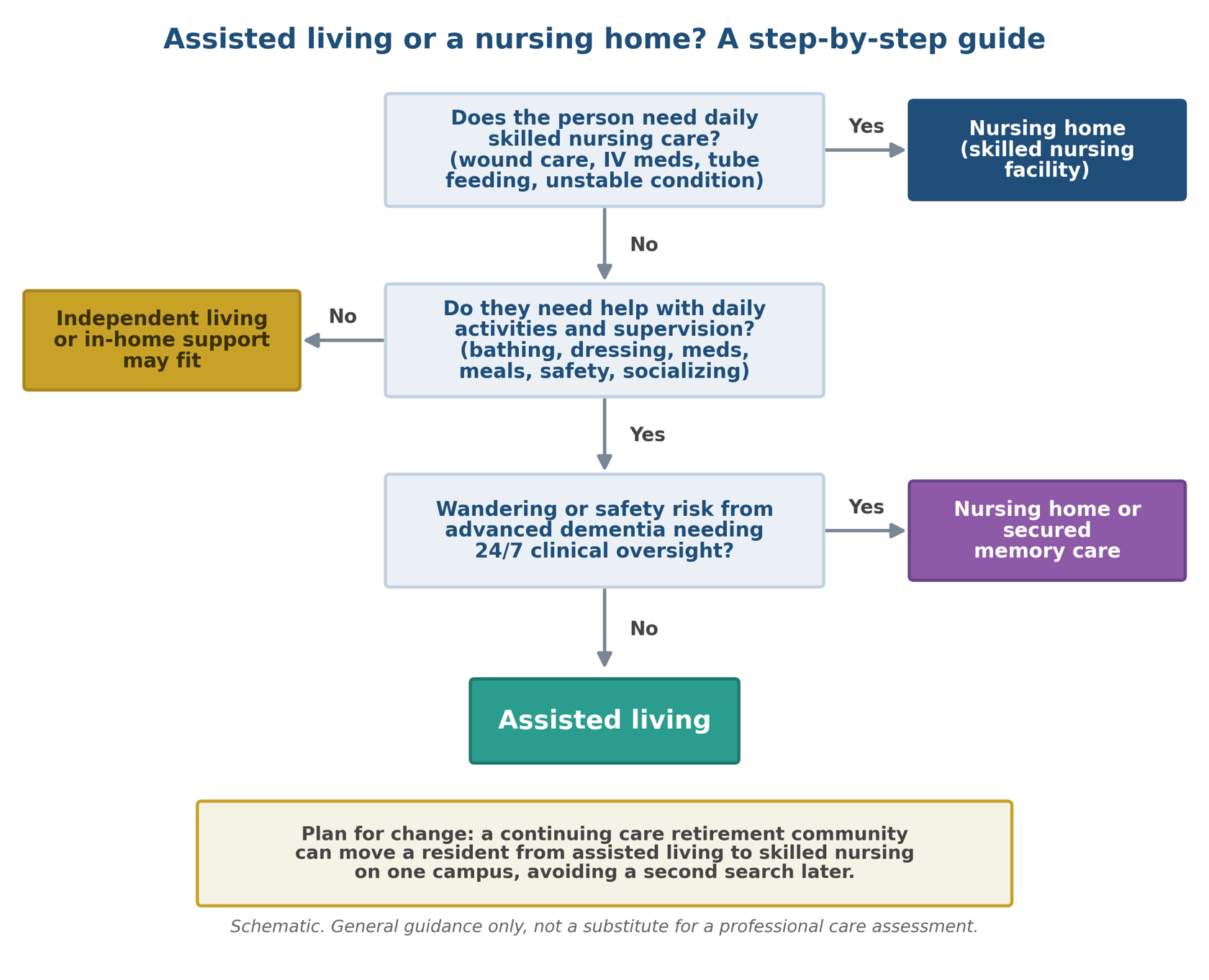
Figure 4. A step-by-step guide to choosing between assisted living and a nursing home. Schematic: general guidance only, not a substitute for a professional care assessment.
Start with medical need. If the person needs daily skilled nursing, close monitoring of an unstable condition, or services such as wound care, IV medication, or tube feeding, a nursing home is the setting equipped for that. Assisted living is not.
If skilled nursing is not needed daily, look at the activities of daily living. If the person mainly needs help with bathing, dressing, medications, meals, and staying socially engaged, assisted living is usually the better fit. It offers support while preserving independence, and it costs less.
Then weigh a few practical factors. Consider safety at home, whether cognitive changes create a wandering or supervision risk, how far family lives, and what the budget and coverage will realistically support over time. It also helps to plan for change. Choosing a community that can move a resident to a higher level of care, such as a continuing care retirement community, can spare a family a stressful second search later.
There is rarely a single right answer that fits every family. The goal is a match between the level of care a person needs and the setting built to provide it, reviewed again as needs change.
Expert Perspective: Balancing independence and safety
“When we work with folks looking at different locations of care, we always tell them to get as much information about each specific concern and care need their loved one has. Then try to project how soon another change may occur. Could that change necessitate another move? Most families want the least restrictive level of care, rightfully so. But we always want to balance independence with safety.”
— Byron Cordes, LCSW, C-ASWCM, CMC, founder of Sage Care Management
How can you make either choice work well?
Once a setting is chosen, a few habits help it work as well as possible. Tour more than one community, and visit at different times of day, including evenings and weekends when staffing can be thinner. Ask specific questions: what is the staff-to-resident ratio, how are medications handled, what happens if health needs increase, and what would prompt a move to a higher level of care. Read the contract closely so you understand what the base rate covers and what triggers added fees.
For assisted living, look at how the community handles rising care needs, since that is the most common reason a placement stops working. For a nursing home, look at recent inspection results and staffing data, both of which are publicly reported on Medicare’s Care Compare tool for Medicare- and Medicaid-certified facilities. In either setting, staying involved after the move matters. Families who visit often, build relationships with staff, and speak up early when something seems off tend to see better day-to-day care.
A move like this is rarely easy, but it does not have to be made blind. When the level of care matches the need, the budget is realistic, and the family stays engaged, either setting can support a safe and dignified life. The point is to choose with clear eyes, and to revisit the choice as needs change.
Expert Perspective: Knowing what support is available
“Know what supports you have available to you. Many families of older adults who had to move into a nursing home, as well as older adults themselves, have shared in our research that they did not know what resources or supports were available to them. Many also shared that this information was never provided to them, including by healthcare providers. The million dollar response is: There are a lot of supports available to support older adults to live in their home, like home modifications, housing support, meal assistance, transportation, homemaking, technology assistance, and social support, which indeed varies by state but are available despite one’s income level, so please seek this information out. A good place to start is contacting one’s local Area Agency on Aging, which connects older adults to services and supports available in their community. One can do so through the Eldercare Locator or by calling 1-800-677-1116.”
— Jasmine Travers Altizer, PhD, MHS, RN, FAAN, Dean’s Associate Professor Chair for Research Acceleration, New York University Rory Meyers College of Nursing
Frequently asked questions
What is the main difference between assisted living and a nursing home?
Assisted living helps residents with daily activities such as bathing, dressing, meals, and medications, while keeping their independence. A nursing home, also called a skilled nursing facility, provides medical care and 24-hour nursing for people with more complex health needs. In short, assisted living centers on personal care, and a nursing home centers on medical care.
Is assisted living cheaper than a nursing home?
Yes. In 2025 the national median cost of assisted living was about $74,400 a year, while a nursing home ran roughly $114,975 a year for a shared room and about $129,575 a year for a private room. A nursing home costs more because the daily rate includes licensed nursing care.
Does Medicare pay for assisted living or nursing home care?
Medicare does not pay for assisted living, and it does not pay for long-term nursing home care. It does cover short-term skilled nursing care after a qualifying hospital stay, fully for the first 20 days and with a daily coinsurance for days 21 through 100. After 100 days in a benefit period, Medicare pays nothing.
Does Medicaid cover assisted living?
Medicaid does not pay for room and board in assisted living. Most states do help cover the care services a resident receives, usually through a Home and Community-Based Services waiver, but the resident still pays for room and board. Coverage, waiting lists, and participating communities vary a great deal by state, so check with your state’s Medicaid office.
When is a nursing home necessary instead of assisted living?
A nursing home is the right setting when someone needs daily skilled nursing or close medical monitoring, such as wound care, IV medication, tube feeding, or care after a stroke or major surgery. It is also appropriate for advanced dementia with unsafe behaviors that need 24-hour clinical oversight. If the need is mainly help with daily activities, assisted living usually fits better.
Can you move from assisted living to a nursing home?
Yes. Many people move to a higher level of care as their health changes. Continuing care retirement communities make this easier by offering assisted living and skilled nursing on one campus, so a resident does not have to find a new provider. When touring any community, ask what would trigger a move and how transfers are handled.
Is a nursing home the same as a skilled nursing facility?
The terms are used interchangeably in everyday conversation. “Skilled nursing facility” is the more technical name and is the term Medicare uses for the short-term, medically necessary care it covers. Both refer to a setting that provides 24-hour licensed nursing care.
What is the difference between assisted living and memory care?
Memory care is a specialized form of care for people with Alzheimer’s disease or another dementia. It often sits within an assisted living community as a secured wing, with staff trained in dementia care and a layout designed to reduce wandering. Standard assisted living may suit early-stage memory changes, while advanced dementia with safety risks may call for memory care or a nursing home.
How long do people usually stay in assisted living or a nursing home?
Assisted living is typically a longer-term home, where residents stay as long as the setting can meet their needs. Nursing home stays follow two patterns: short-term residents recovering after a hospital stay often leave within a few weeks, while long-term residents with chronic conditions may stay for months or years.
What can help someone stay safe at home before they need assisted living?
Many seniors delay a move by adding support at home, such as help with chores, home modifications, and safety technology. A medical alert system can summon help fast after a fall or medical event, whether the person is at home with a home alert device or out and about with an on-the-go device. These supports can extend safe, independent living and buy time to plan the next step without rushing.
Where do seniors go if they can’t afford assisted living?
The right path depends on income and how much care is needed. Seniors who need daily help but not skilled nursing often rely on in-home aides, subsidized senior housing, or a board-and-care (adult family) home, or they move in with family. Those who qualify financially and need nursing-home-level care can turn to Medicaid, which pays for long-term nursing home care in every state and, in many states, covers some assisted living services through a waiver, though not room and board. A local Area Agency on Aging can help sort through what is available nearby.
What disqualifies someone from assisted living?
Assisted living is licensed for help with daily activities, not around-the-clock medical care, so a community generally cannot admit or keep someone whose needs go beyond that scope. Common reasons include needing daily skilled nursing, being unable to move without a two-person transfer or a mechanical lift, having an unstable or complex medical condition, or posing a safety risk from severe wandering or aggression the community is not equipped to manage. Each state sets these limits, and a health assessment before the move determines whether a person is a fit. When needs are higher, a nursing home or secured memory care is usually the safer setting.
At what age do most seniors move into assisted living?
Most people move in during their 80s. National data show that more than half of assisted living residents are 85 or older, with a median age in the mid-80s. Age itself is not the trigger, though. The move usually follows a change in health or safety, such as more frequent falls, memory decline, or trouble managing medications and daily tasks alone.
What is the biggest drawback of assisted living?
Cost is the most common concern. Assisted living is usually paid out of pocket, and Medicare does not cover it, so monthly fees add up and can rise as care needs grow. The other limitation is medical. Assisted living is built for daily support rather than skilled nursing, so a resident whose health declines significantly may eventually need to move to a nursing home. Touring several communities and asking how they handle rising care needs lowers the odds of an unexpected second move.
What can you do if an aging parent refuses assisted living?
Start with a calm conversation about what is driving the refusal, which is often a fear of losing independence rather than the move itself. Bringing in a neutral third party, such as their primary care doctor or a geriatric care manager, often carries more weight than a family member alone. In-home support can serve as a bridge while everyone adjusts, and pairing it with safety tools helps; families weighing that option can compare what a medical alert system costs before deciding. If safety is at immediate risk and the person cannot make informed decisions, an elder law attorney can explain the available options.
References
- Long-Term Care Facilities: Assisted Living, Nursing Homes, and Other Residential Care | National Institute on Aging. https://www.nia.nih.gov/health/assisted-living-and-nursing-homes/long-term-care-facilities-assisted-living-nursing-homes.
- Robert Mollica, B. L. State Medicaid Reimbursement Policies and Practices in Assisted Living.
- Overview of Assisted Living Facilities | Congress.gov | Library of Congress. https://www.congress.gov/crs-product/IF11544.
- eCFR :: 42 CFR 483.35 — Nursing services. https://www.ecfr.gov/current/title-42/chapter-IV/subchapter-G/part-483/subpart-B/section-483.35.
- Federal Register :: Medicare and Medicaid Programs; Repeal of Minimum Staffing Standards for Long-Term Care Facilities. https://www.federalregister.gov/documents/2025/12/03/2025-21792/medicare-and-medicaid-programs-repeal-of-minimum-staffing-standards-for-long-term-care-facilities.
- Cost of Long Term Care by State | Cost of Care Report | Carescout. https://www.carescout.com/cost-of-care.
- SNF Care Coverage. https://www.medicare.gov/coverage/skilled-nursing-facility-care.
- What Services Does Medicaid Cover in Assisted Living Facilities? | KFF. https://www.kff.org/medicaid/what-services-does-medicaid-cover-in-assisted-living-facilities/.
- Melekin, A., Sengupta, M. & Caffrey, C. Residential Care Community Resident Characteristics: United States, 2022. NCHS Data Brief https://doi.org/10.15620/CDC/158327 (2024) doi:10.15620/CDC/158327.
- Medicare and Medicaid Programs: Minimum Staffing Standards for Long-Term Care Facilities and Medicaid Institutional Payment Transparency Reporting Final Rule (CMS 3442-F) | CMS. https://www.cms.gov/newsroom/fact-sheets/medicare-and-medicaid-programs-minimum-staffing-standards-long-term-care-facilities-and-medicaid-0.