Steve Popovich builds AI fall detection for a living and thinks the term is badly overused. He explains what families are really worried about when they push back on monitoring, how a system separates a genuine fall from a bumped wrist, the small feature that keeps people wearing one, and the promise he says his own industry oversells.
Key Takeaways
- The objection is to cameras. Popovich says people take readily to systems that are not watching them.
- The intelligence sits in what happens before and after the impact. Reading only the moment of impact is what produces false alarms.
- Risk scoring is the step after fall detection. He scores risk from changes in standing and walking. Medical Guardian’s COO has discussed the same shift toward predictive analytics in senior care.
- A soft fall is an early warning. He treats a slide to the floor as a signal to act on, especially for people living with dementia.
- Two devices with identical sensors can behave completely differently. He treats accelerometers and gyroscopes as one bucket. What separates devices is the software reading them.
- Knowing the day of the week turned out to matter more than the time. Popovich found the small features are what keep a device on someone’s wrist.
Disclaimer: This article is general information, not medical advice. Decisions about devices, monitoring, and medical conditions should be made with a doctor. If a fall may have caused an injury, call 911.
Steve Popovich founded Clairvoyant Networks in 2015, after a family member’s Alzheimer’s diagnosis sent him looking for technology that could tell him how they were doing between visits. He could not find it. It was his fourth company, following a career in connectivity and the Internet of Things. Clairvoyant builds and sells under the name Theora Care, out of Austin. Its fall detection and fall risk platform, Theora 360, was named a finalist in the Longitude Prize on Dementia, a competition funded by Alzheimer’s Society and Innovate UK that gave each of its 5 finalists £300,000 to build a working prototype. Popovich was named a Fellow of the Texas A&M University Center for Population Health and Aging, and his company has an NIH-funded grant to develop next generation fall risk prediction using new technology with Texas A&M University as the research partner. Here he explains how the technology works and where it stops.
This conversation has been edited for length and clarity.
On the privacy fear that shapes everything
What’s the biggest misconception people have about using AI to monitor someone with dementia?
That machines are always watching you and invading a person’s privacy. Some AI solutions do use always-on video imaging to determine things like falls or changes in the risk of falls. However, not all AI solutions involved with protecting the care of older adults are the same. For example, other AI-based fall detection systems leverage technology not only in the wearable but also the almost limitless processing power in the cloud. They use the cellular network to connect the wearable and the cloud-based system only when a fall might be occurring, rather than keeping that backend constantly processing information.
Do you find that customers are wary of AI in fall detection technology, or embrace it?
The term AI is very overused, and the systems are using AI in different ways. I see people generally embracing the non-intrusive, non-video-related approaches. People want to age in place with dignity and leverage technology that is respectful of privacy.
Where’s the line between helpful monitoring and surveillance, and who should get to draw it?
This is always a difficult question. The way I look at the issue is this: are we respectfully adding quality of life for a person aging and their caregivers, while maximizing their privacy? And, we believe the person aging and their caregivers need to make the final decision on quality of life, peace of mind and helpful monitoring and surveillance.
On how AI fall detection tells a real fall from a bumped wrist
You’ve said most fall detection runs on the device itself. What do you do differently?
We don’t just have algorithms inside the wearable device like everybody else, at least in the first generation of fall detection. We have some algorithms inside the wearable, and then more importantly, we have this always watching or looking at what happened right before the suspected fall, what’s going on during that fall episode, and then what’s happening after that suspected fall.
So for example, you’re walking down a hallway, you bump your wrist, which has the wearable device on it, against a door jamb. It’s a catastrophic impact if you just look at it from an accelerometer data perspective. But if you look at the data before that impact occurred, you could tell that you’re walking. And then you have the impact. And then you can see, within a second or two, you’ve taken some more steps. You obviously have not fallen.
We built more and more intelligence like that, primarily in the back end where we have almost an infinite amount of capacity for processing things and building AI. We built a neural network engine which teaches a machine how to be smarter and smarter.
How do you cut down on false alarms without missing a real emergency?
This is one of the big benefits we see of incorporating AI into systems. We look at body movement data before, during, and after the suspected fall event. This kind of unique feedback loop enables us to get smarter and smarter.
You want to have minimized false positives and false negatives. That’s kind of the secret sauce on that part of this technology.
First, the alerts go to the individual that’s wearing the device, to make sure they have an opportunity to cancel that kind of a fall. If no response or an alert is confirmed, the alerts, of course, go to the caregiver.
Is 100% accurate fall detection possible, or will it ever be?
Yes. Technology currently in early pilot testing is showing promising results toward eventually achieving 100% accuracy for not just fall detection, but we believe it will also help us prevent some future fall events by understanding changes in fall risk assessments.
On moving from detecting falls to spotting risk earlier
Your company builds toward predicting a fall before it happens, not only detecting one after. How does that work?
With our newer wearable devices, we are looking at changes in standing and walking. We are working with a leading university team of experts to help us accurately interpret body movement data. For example, changes in how we measure walking gait speed are one indicator of fall risk.
What can that kind of system realistically see coming?
Ultra-low-power 3D radar gives us detailed data to feed into our AI systems, so we can score fall risk predictions uniquely for each resident.
What is Dr. Marcia Ory’s team at Texas A&M doing with your data?
We’ve done testing with test subjects that have dementia, that are older, so they’re good test sets for the products we develop, like fall detection and fall risk analysis. Today what we’re doing with Dr. Ory and her team primarily is being able to take huge data sets that we have and analyze, how do we prevent a fall?
We’re not going to prevent all falls. But how do we use this massive amount of information we have, what we call anomalies in our back-end systems?
On why a soft fall matters as much as a hard one
Theora treats a soft fall and a hard fall differently. Why does that distinction matter to families?
Soft falls are less likely to cause serious injuries. However, they can be early indications of stability issues that could later cause a very serious, life-changing injury like a hip fracture. I believe in many cases you can use those early signs to give more attention to physical therapy stability therapies or making changes in living spaces. Also, statistically, people living with dementia face a double whammy: they have greater injury with a fall than someone without dementia.
On wandering, and what GPS can do
The Alzheimer’s Association says 6 in 10 people living with dementia will wander at least once. That is where you started. Why there?
The first thing we did was related to wandering, because 60% of people with Alzheimer’s will wander at one point in that disease. And so we did a project with A&M. That’s published everywhere, 60% at one time or another. Wandering also increases the risk of falling – a huge challenge on the caregiver side.
Where does the technology genuinely help with wandering?
Always-on cellular connectivity combined with GPS mapping can provide caregiver-defined “Safe Zones,” which can be used to determine when a person with dementia may be wandering. We work with families, law enforcement agencies, and other community projects across North America to help caregivers keep people living with dementia safely aging in place longer.
On what families should look for in a device
Devices advertise accelerometers, gyroscopes, barometers. What should families be comparing instead?
A gyroscope is basically using an accelerometer to do what it does, so I look at those as one bucket. And I think that’s a good start.
What we really want to be able to do is analyze the information that you’re getting from those kinds of sensors. And that’s where AI really comes in.
On what makes someone keep wearing it
What have you learned about building something people actually want to keep wearing?
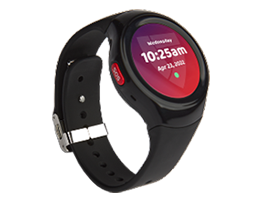
We continue to learn which features are valuable to the user and can be incorporated into a wearable device to make people want to wear it. Initially, time, date, and day of the week were the key features. Think about how the traditional smartphone has evolved from a device for making calls into something people check for nearly everything. We have the most requested applications on our watch, with many items on the roadmap to further maximize the value of a wearable.
Day of the week seems like a small thing.
When you’re retired and you’re in a facility, it’s confusing what day of the week it is. Which is kind of depressing when I think about it sometimes. But I saw this happening with our users. When we added it to the wearable, you can ask what day it is and it tells you: it’s Tuesday. What time is it? Does it matter what time it is to them? Not so much. But knowing that it’s Tuesday, that’s kind of important.
The original phone you probably got was more of a basic thing, and now the smartphone, I can leave the house without anything else. I can leave my keys, my wallet and everything else, but I can’t leave without my smartphone because of all those apps I’m dependent upon. That’s the evolutionary process that occurs with this technology. The stickiness gets tighter and tighter. And that includes with people that are older too. It may take more time.
There’s also not looking old, or feeling old. So a wearable that looks more like an Apple Watch. All my kids have Apple Watches. I’ve got 3 kids. I didn’t buy them for them, but they all, for whatever reason, got them.
What has co-designing with people living with dementia taught you that engineering alone wouldn’t?
The short answer is lots. However, the better question is not just co-designing with the person with dementia, but also their family and professional caregivers. This lived experience gives us clear-cut requirements to continue to build high-value products and solutions. For example, most of our support team has personal experience as a dementia caregiver.
On why this is happening now
Why is this arriving now?
Five years ago you wouldn’t be able to do what we’re doing today because it would be cost prohibitive. You’ve got multiple things that have occurred technology wise that help enable what we’re doing as a whole, whether working in our company or Medical Guardian or the whole space.
One of those things is cellular connectivity, because cellular connectivity has become ubiquitous in the last 15, 20 years. And it’s become dirt cheap as far as the cost of that connection. My last company pioneered using cellular networks back in like 2000, for gas station C stores, and I was doing early work in remote patient care for places like University of Minnesota Medical. In those days it was too expensive. You’d pay, I don’t know, more than 100 times what the cost is now.
And in parallel, my last company also pioneered doing what they call Internet of Things connectivity using cloud platforms. We partnered early days with Amazon, AWS, before people could even spell AWS or knew who they were. They thought Amazon was still selling books to college students. But with those kinds of cloud platforms you had kind of this infinite capacity and scalability, and then you could take things like AI as far as an application and be able to munch all this data quicker and quicker.
What does the scale of the data make possible?
One of the things we’re blessed with is a massive amount of data sets to leverage AI and our neural network platform to analyze quickly. In the old days, and I say the old days, maybe 5 years ago, you’d have somebody in academia, they might say, okay, we want to do a research project on how to detect something. And they’d have a dozen, maybe a couple dozen test subjects they could use for the study.
Now we kind of digitize those life patterns. That’s what I think is super exciting for lots of things that are actually more clinical.
Fall detection is one of those early things for us, but there’s a lot of other things as well that are going to percolate up as we get smarter on how to leverage the data.
On what the industry overpromises
What’s the most overpromised claim you see in this industry right now?
That a single device can be a total solution. Each caregiving situation is unique and usually needs more than one gizmo to help. Situations tend to evolve, and they benefit from more data points or devices.
What emerging technology are you most excited about?
We are in a very interesting time in technology, where leveraging low-cost, high-bandwidth, almost-everywhere connectivity with the almost infinite scalability of cloud computing gives us lots of opportunities to completely change how and where people age. We are only beginning to see what can be accomplished with age tech for the growing population of older people.