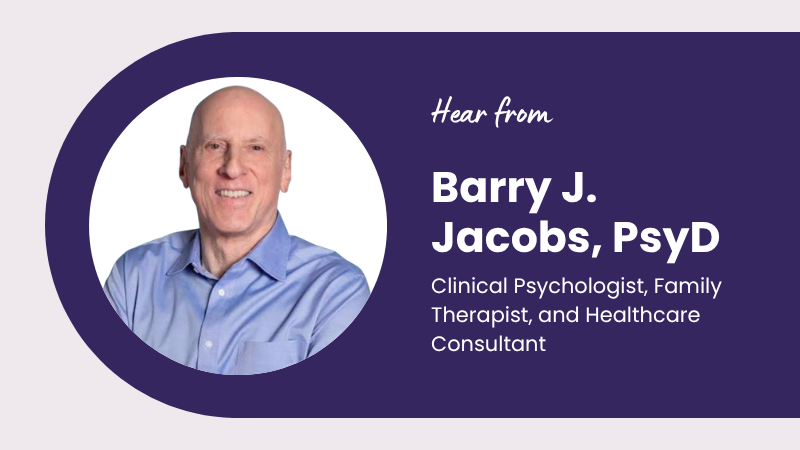

A clinical psychologist who spent seven years caring for his own mother and stepfather explains why guilt makes distant family members overstep, what actually quiets a racing mind at 2 a.m., and how siblings can stop fighting long enough to build a plan.
Key Takeaways
- Guilt about living far away often turns into overcorrection. Distant family members start giving orders and second-guessing decisions, which makes the day-to-day caregiver’s job harder rather than easier.
- The better opening is a question, not advice. Ask the person on the ground what they actually need. The answers tend to be concrete, and rarely what the distant relative assumed: take over the bills and the bank accounts, send money, or fly in and run the household for two weeks so the primary caregiver can take an actual vacation.
- Caregiving is stressful because it demands constant adaptation. Worry crosses into anxiety when it becomes uncontrollable and starts to circle, and that shows up as trouble falling asleep or waking in the middle of the night unable to shut the thoughts off.
- Jacobs works in three layers: reduce the real load first, then use behavioral tools such as aerobic exercise and social contact, then challenge the catastrophic thinking that anxiety runs on.
- Family conflict usually takes one of two shapes: too few people helping, or too many cooks in the kitchen, each with a different view of what the parent needs. Both respond to the same sequence: build a shared understanding of the diagnosis, divide tasks by real availability, then revisit the plan every few months.
Barry J. Jacobs, PsyD, is a clinical psychologist, family therapist, and healthcare consultant. A former magazine journalist, he is the author of The Emotional Survival Guide for Caregivers: Looking After Yourself and Your Family While Helping an Aging Parent (Guilford, 2006) and coauthor with his wife, Julia L. Mayer, PsyD, of AARP Meditations for Caregivers: Practical, Emotional, and Spiritual Support for You and Your Family (Hachette, 2016), AARP Love and Meaning After 50: The 10 Challenges to Great Relationships—and How to Overcome Them (Hachette, 2020), and The AARP Caregiver Answer Book (Guilford, 2025). He has also written a self-help column for caregivers for AARP.org since 2013. A board member of the Caregiver Action Network, a national family caregiver advocacy and support organization, and a former director of behavioral sciences for the Crozer Health Family Medicine Residency, he maintains a psychotherapy practice in Media, Pennsylvania, specializing in supporting individuals with chronic and serious illness and their caregivers. Beyond his professional expertise, he also has personal experience: for seven years, he was the primary caregiver for his stepfather with Alzheimer’s disease and mother with vascular dementia.
This conversation has been edited for length and clarity.
On this page:
On Caregiving from a Distance Without Taking Over
On Why Caregiving Is Inherently Stressful
On the Line Between Worry and Anxiety
On the Three Kinds of Sleep Trouble
On Reducing the Load First
On Exercise, Social Support, and Getting Back to What You Used to Do
On Catastrophic Thinking and What You Can Actually Control
On What He Learned Caring for His Own Mother and Stepfather
On Families with Too Few Helpers, and Too Many
On Building Consensus, Then a Plan You Revise
What Does the Process Look Like?
On What Has Changed for Caregivers in Twenty Years
On the One Thing Every Caregiver Should Remember
References
Medical Disclaimer: This interview describes one clinician’s professional perspective and is provided for general information. It is not a substitute for individual medical or mental health advice, diagnosis, or treatment. If you or someone you care for is struggling with anxiety, depression, or sleep, speak with a qualified health professional about your specific situation.
On Caregiving from a Distance Without Taking Over
Thank you for making the time. You gave us a line for our article on caring for a parent from far away that reframed the whole piece. What is the biggest problem you see in families where one adult child lives at a distance, whether that is an hour away or hundreds of miles?
That is the biggest issue, because people want to be useful. Oftentimes people feel guilty that they moved so far away. Even if they moved far away 20 years ago, they feel like, well, maybe I should be there, maybe I should move back, or maybe I should never have moved away. And they end up being overly assertive as a way of compensating for some of the guilt that they feel. But as a consequence they can really irritate the folks that are there day to day doing the work. Our experience with the day-to-day caregivers is that you have this person living at a distance who really does not understand what is happening day to day but is being bossy and is being a hindrance and not really helping. In fact, making caregiving more difficult.
Several things are tangled together there. There are practical reasons people move away. There is the emotional side, where they feel they should be closer and cannot be. And they are genuinely worried, so they want to be sure the care is good. How does someone balance all of that?
I think the only way for them to balance it out is to have conversations with the people who are doing the day-to-day work. And really say to them, in so many words, you tell me, what do you need me to do?
Sometimes the folks that are day to day will say things like (and I have heard this with my own clients), send money. That is all I want. Or they will say, you really want to help? Take two weeks off sometime this summer, and come, and you be the day-to-day caregiver, and let me get a vacation. Or they will say, you are taking over the billing. We are going to send you all the bills, the bank account numbers. This is your job.
The day-to-day caregiver will define what the long-distance caregiver’s role is, and everybody is better pleased. It is much better catering to the day-to-day caregiver’s needs and preferences than deciding at a distance what is best for everyone.
So the work is tuning in to what the person on the ground actually needs, rather than dictating from a distance.
Correct. The person at a distance cannot be second-guessing the folks on the ground. They cannot be saying to them, I do not think you should be seeing this doctor, go to this other doctor instead, because I read about that other doctor online, and therefore I know better than you.
They think they are being helpful. They are not being helpful.
On Why Caregiving Is Inherently Stressful
Your AARP column recently took on a caregiver whose sleep had been wrecked by racing thoughts and constant nighttime interruptions. That piece is not only about people at a distance. Before we get to sleep itself, what makes caregiving stressful in the first place?
When human beings have to adapt to changing circumstances, they experience stress. That could be negative stress, like losing a job, or having someone in the family die. Or it could be positive stress. It could be getting a job or moving into a great new neighborhood in Philadelphia, but finding that you have got to adapt. You have got to figure out how to turn the electricity on and get your internet up and all that good stuff.
And so caregiving entails a tremendous amount of change. It entails really almost continuous change, because circumstances change. And so caregiving is inherently stressful.
If you look at something like the Caregiving in the US report, which comes out every five years, and the most recent report came out in 2025, it finds that 85 percent of the caregivers surveyed said that caregiving was stressful or highly stressful. And that means about 15 percent of folks say it is not stressful at all, and I frankly am doubtful that they are not stressed at all.
Editor’s note
Dr. Jacobs’s recollection is close to the published data. Figure 36 of Caregiving in the US 2025 reports emotional stress on a five-point scale. Seventeen percent of family caregivers chose 1, “not at all stressful,” which leaves 83 percent reporting stress at some level. Thirty-eight percent rated it a 4 or 5, and 64 percent rated it 3 or higher, the “moderate to high” share the report highlights in its summary.1 The 64 percent and the 38 percent are therefore different cuts of the same scale rather than a contradiction.
How is stress defined in a survey like that? Is there a controlled definition, or is it subjective?
I think it is very subjective. I think it is the way we use it in the vernacular.
When people are stressed, they have characteristic reactions. There are some people who, when stressed, will become very quiet, and other people, when stressed, will become very talkative. Some people, when stressed, will kind of shut down and nap more, and others will sleep less. We all have our ways of dealing with stress.
On the Line Between Worry and Anxiety
Where is the line between the ordinary worry that comes with the job and worry that has tipped into anxiety, the kind that a caregiver should treat as a problem in its own right?
When stress builds to such a point, and worry builds to such a point, that it really feels uncontrollable and overwhelming, then we are not just talking about dealing with the normal stresses of caregiving. We are talking about a caregiver whose response to stress is more problematic.
They are not going to function at their optimal level. They are going to feel tense. They are going to feel preoccupied with the worries. They are going to have difficulty concentrating. And in addition to that, they may have a specific kind of sleep problem.
Anxiety is not uncommon in the population in general, but it is more common with caregivers, who happen to have a lot of real worries. It is a question of how those worries mushroom, and whether they feel out of control.
What we all want to be able to do is to have certain problems that we have to solve. Maybe we worry about those problems, and those problems might be even something like, I have to get these forms in on a certain time, or I have to get my care receiver to the doctor’s appointment by 10 o’clock tomorrow morning. Those are challenges, and so you may worry about them.
But if you are so preoccupied with those worries, and if they kind of circle through your brain, what we call rumination, where you cannot stop worrying, then that is anxiety. That is a problem.
I have seen the term sandwich generation used for caregivers who are raising children and helping a parent at the same time. I imagine the anxious thoughts come at them from every direction.
Basically, the relationship here is, the more responsibility you have, the more stress you have, the more prone you are going to be to anxiety. And if you are someone who already has a proneness to anxiety, maybe you were born with that, or maybe that is your inherent nature, you were always a nervous Nellie.
You throw the stress in there. You have someone who is a sandwich generation caregiver, and they have to take care of their parent and their child, and they have a full-time job, being pulled in many directions. Then what was stress and worry blossoms into anxiety.
On the Three Kinds of Sleep Trouble
You mentioned a specific kind of sleep problem. What does anxiety do to sleep, and how is that different from other sleep trouble?
What we call insomnia, the inability to sleep adequately, comes in different types of sleep disturbance:
- There are people who have trouble getting to sleep.
- There are people who have trouble staying asleep.
- And there are people who wake up too early.
The rule of thumb in psychology is, if you are worrying a lot, worrying about what is going to happen the next day, and what is going to happen the day after that, and what is going to happen down the road, and what if my person gets really sick, and what if they die, and how am I going to handle that. You can go on and on and on.
As one feature of anxiety, one symptom of anxiety, they can have difficulty falling asleep, because they have all these worries. What is actually more typical is people are able to get to sleep, then wake up in the middle of the night, say, to use a bathroom, and it is one of those things where they wake up and kind of bolt upright with a head full of worries, and they cannot turn it off. They are just saying, oh my Lord, what am I going to do about this? And what am I going to do about that? And what about this? That anxiety will then keep them up for long periods of time.
The last type of sleep disturbance that I mentioned is that you wake up earlier than you ought to. They will set the alarm for 7:00, and you wake up 5:30 instead, and then you cannot get back to sleep. That is more characteristic of depression. That is a hallmark of depression, early morning awakening. But the sleep problems due to anxiety, you have trouble with sleep onset and with sleep maintenance, those two things.
On Reducing the Load First
Every situation is different, but where do you start with someone in that spot?
Let us take the components one at a time. Stress increases worry, worry increases anxiety, and anxiety increases sleep issues. So, we will start from the beginning here. Can we reduce the stress of caregiving?
Take a sandwich generation caregiver. Yes, you can reduce the stress of being a sandwich generation caregiver if you are able to take a leave from your job, so you have less responsibility. Or if you have someone help take care of your care receiver, your parent or grandparent, so that you are sharing that burden. You are not doing that yourself. That decreases stress. Any way that you take some things off your plate.
Less stress means less worry, and probably less anxiety. The first thing we try to do, as psychologists, is change the stressful situation.
Not everyone can step back from a job. Some people depend on the income. Is it a matter of taking an inventory of what you can and cannot let go, and then reducing carefully from there?
Absolutely. Exactly as you said, Eli. There are lots of ways that people can change the stressful situation, but they have to be practical and realistic. They cannot step away from the job because they need the money to pay their bills. That is not going to be possible. If there is no one else from the family who they can recruit to help with caregiving, then it is all on them. But for many people there are possibilities for them to at least consider, at least try.
When I work with caregivers in psychotherapy, the first thing we do is ask, what do we do to change the stressful situation? Let us do some problem solving. Let us look at all the different components of this and see what stressors we can reduce. That is the very first thing.
On Exercise, Social Support, and Getting Back to What You Used to Do
So the first layer is changing the situation itself, taking real load off the plate. What is the second?
The second thing is, okay, we have reduced stress as much as we can, and you are still worrying a lot, and you are worrying so uncontrollably that it is tipping into anxiety. So how do we stop the worrying? I will give you two different methods.
There are behavioral methods of decreasing anxiety. We know that, for instance, physical exercise is an excellent way to reduce worrying and anxiety, because of the way we literally change our physiology by having the release of endorphins. We worry less, we have less anxiety. So physical exercise is really important.
Any recommendation on the type of exercise, and how far down the intensity scale it still counts? Aerobic, something gentler, or does anything that gets someone moving help?
Aerobic is better than doing chair yoga, for sure. But the idea here is that people have things they have maybe always done, and they should do more of them.
One of the things that happens in caregiving is that the things people typically do to take care of themselves, they often stop doing, because they are so focused on the person they are caring for. A lot of what I do is try to get people back to the things that they have always done. That may be that they play pickleball, or that they like to jog, or maybe they do not do anything that rigorous, maybe they like to walk. All those things are good.
And the other thing, we know the social supports. Just having people. When people feel less alone with a challenge than they are, it kind of buoys them up a little bit. They feel like they are going to be okay. That is a way of reducing worry.
On Catastrophic Thinking and What You Can Actually Control
And the third?
The third way of reducing worry, a kind of general way, is a technique from cognitive behavioral therapy, which is a very well-known form of psychotherapy, where I help people look at the things they say to themselves in their mind about the situation, and whether those things are in fact true or not.
People sometimes will have these kinds of beliefs, like, unless I get to the doctor’s office with my care receiver by 10 o’clock, I have blown it. I have blown the appointment. And maybe there is a little bit of reality to it. Maybe they show up at 10:30 and they have lost the appointment.
But 10:01 or 10:05 is probably fine.
Exactly. But people get very rigid. They get very worried, overly worried. People also do something that is called catastrophic thinking. They think to themselves, well, if I miss the doctor’s appointment, then something terrible is going to happen to my loved one. Because they did not go to the appointment, the doctor did not get to examine them. Because the doctor did not get to examine them, they have some defect, some heart defect or something else, which is therefore not going to be discovered, and therefore some stroke or heart attack is not going to be prevented, and then they are going to have a heart attack and stroke, and it is going to all be my fault.
That linking of thoughts, that chaining of thoughts leading to a kind of catastrophic conclusion, is a very characteristic habit of thinking for anxious people.
On the inventory we talked about earlier: if someone is already thinking in an anxious way, doing that inventory alone seems risky. They will probably let go of nothing, or of the wrong things. Is a third party useful there?
I think having someone who can give you some feedback and kind of check your anxious tendencies is a good idea. I like that idea.
And when you talk about taking inventory, what comes to mind for me is the serenity prayer. We have to have the courage to change the things we can, but we have to be able to accept the things that we cannot change. Accepting the things we cannot change, I think, is hard for many of us. We want to be able to control the circumstances around us as much as we can, because that gives us a greater sense of control, of comfort and agency. But many of the things in our lives we cannot control.
That is also true for caregivers. If someone is worried that their care receiver is going to fall, and then the care receiver falls, do they then take responsibility for the fall as something that they should have been able to prevent and did not? Or can they accept that there are some things that they cannot change? People who have mobility problems fall. You can stand right in back of the person and they still may fall.
That lands hard for the families we write for. According to CDC data, about one in four adults 65 and older reports a fall in a given year, so for a great many caregivers the fall is going to happen no matter how carefully they hover.2 It is one reason families turn to tools like automatic fall detection, which shorten the time someone spends on the floor rather than promising the fall will never come.
For someone who is a caregiver with anxiety, they would not be able to distinguish between what they realistically can do and what they cannot do, and they will hold themselves responsible for things that they really cannot do, and then feel guilty if those things happen, and feel tremendous guilt in anticipation of failing the person that they are caring for, and feeling that they were a terrible person, maybe a terrible family member.
So, the whole idea of cognitive behavioral therapy is to help people become more aware of that chaining of thoughts and that catastrophic thinking, and then prevent themselves from doing it. Awareness of it gives people the power of saying, I do not have to reach that catastrophic conclusion, because the fact is, it is a very low probability event. Why am I going to put so much stock in that low probability event?
Bringing it back to sleep: if you deal with the anxiety effectively, do the sleep problems ease?
Certainly; you will be able to decrease the anxious ruminations that probably interfere with the onset of sleep and the maintenance of sleep. Early morning awakening is another story, but you will be able to improve the quality of your sleep if you decrease the anxiety. And you decrease the anxiety by really seeing what is worth worrying about and what is not worth worrying about.
And also, as I said right at the beginning, by changing the amount of stress you are experiencing, by changing the stressful situation as much as you can.
And that probably means talking it through with someone. A therapist, ideally, or someone who works in this area?
What I would say, Eli, is that the vast majority of caregivers really do not need a therapist, nor will they ever go to a therapist. But people need a family member. They need someone they can bounce ideas off of.
They need somebody to give them a little bit of feedback like, hey, you are taking on too much here. You are holding yourself too responsible, and you are worrying too much. And then hopefully the caregiver can take that information in.
On What He Learned Caring for His Own Mother and Stepfather
You cared for your own mother and stepfather, both of whom had dementia. Did you catch yourself doing this?
In the years that I took care of my mother and stepfather, particularly early on, my wife and I had moved them up from Florida to live near us outside of Philadelphia. And when we moved them up, I felt very responsible for them. I had to make sure they ate well. I had to make sure that they went to all the medical appointments in time. And I had to make sure that they were entertained and were happy.
And there was a lot, because I was a sandwich generation caregiver. I had teenage children who I had to worry about, and I had a wife, and I had to maintain that relationship. I had a full-time job. So, I am googling all these things, and then I am putting all this pressure on myself, which was unrealistic.
And my wife was able to say to me, your expectations for what you can do for your mother and stepfather are unrealistic and excessive. She helped me modify my expectations. I would still hold myself accountable for doing certain things for them, but not necessarily setting the bar so high that I could not possibly reach it. There is no point in setting the bar so high that you feel like a failure.
I could not entertain them all the time, because I was not with them all the time. I could not make them happy, because the fact is they were dealing with some very difficult medical and cognitive issues. I was not going to have the ability to make them happy, but I had to accept that that was something I could not change.
What did she actually get you to change?
I felt really early on that we should be eating dinner with them three or four times a week. And my wife basically said, that is just too much. It is too much. She did not want to spend three or four nights a week with them anyway either.
So, we dialed it back to once or twice a week. And it was not like I was terribly depriving my mother and stepfather of my company. They were fine with it. They were not saying to me, we need to have dinner with you every night, or three or four times a week. I was the one saying that. So that was a very concrete way of reducing the stress that I was placing upon myself, because I was reducing the expectations.
Another was that my wife would remind me I needed to do things to take care of myself, to keep myself replenished, so that I could sustain what turned out to be seven years of caregiving for them. That meant doing the physical exercise, playing the basketball once a week that I always played.
During the caregiving period, I thought that I should not be playing basketball, because the time I would spend playing basketball, I could be having dinner with my mom and stepfather. I could be doing other things with them. So, my wife, again, helped me make that course correction. No, you need that physical exercise, because that is what is going to actually enable you to do a better job for them. That is going to put water back in the well.
On Families with Too Few Helpers, and Too Many
Your wife was a good resource to have. Not everyone has that. And sometimes the opposite problem shows up, where there are too many cooks in the kitchen. In large families, siblings end up arguing over the right way to do everything, and the person doing the day-to-day work gets outnumbered. Any advice on that?
There are two types of issues that come up in families. One is where too few family members agree to participate in caregiving. Then the whole caregiving load falls on one or two people’s shoulders. And that causes an enormous resentment on the part of the caregivers toward the folks that are not stepping up. That is one scenario.
The scenario that you were talking about is the opposite of that. Lots of people who want to participate, but they have very, very different ideas of what a caregiving plan should look like, or who is going to do what for whom. I work with a lot of families in both scenarios.
In that second scenario, I generally do a number of different things. The first and most important thing I do is to help all these different family members, and it could be a group of adult siblings, develop some sort of shared understanding, some sort of consensus about what is going on with the parent or parents. Oftentimes, especially with certain illnesses with vague symptoms early on, like neurological disorders, like Parkinson’s, or any kind of dementia, people see the elephant from different perspectives.
They have very different ideas of what is going on. They have different interactions with a parent. They also have different relationships with that parent. They bring different expectations to that parent. They see different things in that parent.
So, with dementia, you will have a couple of adult siblings who say, I think something is wrong with dad, I think we need to get dad evaluated. Or, dad has been evaluated, and the doctor thinks he has mild dementia. And the other siblings will say, dad has always been forgetful. This is nonsense. You are trying to take over dad’s life. And then there is all this tension and conflict.
There is also the independent politics between the siblings, separate from the relationship each of them has with the parent.
Absolutely. It gets very, very complicated, especially when you have this long history. So, you get sibling rivalry. You get the older siblings who are used to bossing around the younger siblings. You get differences in gender expectations, where there is a kind of general understanding that all the daughters will take care of it and the sons do not have to do anything. So, all that is in the mix.
Getting back specifically to your question of too many cooks. Even if you have everybody who agrees that dad now has dementia, you have three different siblings with three different ideas of what should be done for dad. One says dad should be put in a facility, another says no, dad should be able to stay home forever if that is what he wants to do, and the third one says something completely different.
How do they then develop consensus about what the plan is going to be, and who is going to be in charge? Because caregiving is not typically democratic. There is usually a primary caregiver who does most of the work and makes most of the decisions. And then there may be some legal issues about the parent having identified a power of attorney, a medical power of attorney, a financial power of attorney, and that will come into play.
This is where family members, or sibling groups in particular, will often struggle. How do they find ways of cooperating with one another, as adults, maybe for the first time in their lives, to be able to move forward with a plan that they will implement in order to best help that parent?
On Building Consensus, Then a Plan You Revise
So the shape of it is: take a breath, get everyone together, come up with a plan, and divide up the tasks.
Not easy. It often has to be negotiated.
It is easier said than done most of the time. Where do you lay out how it should work?
This is the latest one that my wife and I wrote, The AARP Caregiver Answer Book. This book has nearly 150 questions and answers, but the chapter on siblings, to give you the exact title, is called Collaborating with Siblings and Other Relatives.
It is about a three-part process. And oftentimes it requires having, as you pointed out earlier, an outside facilitator to help, because things can get very heated. When emotions go up and people get really angry at one another, nobody hears one another and no one cooperates with one another.
So, you have someone who calms the waters, helps everyone clarify what they are saying, and clarifies understanding around the room, so people really talk to one another and begin to problem-solve together.
What Does the Process Look Like?
Part one: build a shared understanding of the diagnosis
Even before they get to the caregiving planning, it is developing that consensus about what the parent needs. What is their condition? What is the prognosis? What are the treatments? What are the side effects of the treatments? What are the limitations of the treatments? You get all that medical information, letting everybody have that information, so everyone is working from the same score sheet.
Let us say dad has, we will say, Parkinson’s disease. Parkinson’s disease is a disease which, early on, we have medicine, levodopa. Early on it works great. You usually get four or five really good years of good effect from that medicine. And then the effectiveness of that medicine really tails off. And then people have periods of hyperkinesis and rigidity.3
So, to have everybody in the room and the family understand that the caregiving early on is probably not going to be that hard, but a period of time that is going to come later is going to be much harder, because the treatments are not going to be as efficacious as the current treatments are. We are able to share that information. We are able to form a consensus about what the diagnosis is, and what the prognosis is, and what the trajectory is likely to be.
Part two: divide the tasks by who is actually available
And then you begin to say, okay, who is going to do what for dad? Who is going to take responsibility for this, say, over the next three months? Usually what I write in the book is that you want to meet quarterly. You want to compare notes about what you are seeing, what is working well, what is not working well. You want to revise the plan as needed, and also in response to changing circumstances, because the person you are caring for is changing.
The family members’ individual circumstances are changing too. Maybe someone is more available this quarter of a year than another quarter of a year. Maybe they are a teacher, and the summer is a great time for them to do a lot of work, but when the school year is going on, they are not so available. So, you are having a conversation, a formal meeting, where you are talking about these things. And then trying to put the pieces together into a plan that you are implementing.
Part three: review and revise the plan on a schedule
The third segment of this three-part process is that you have a process by which you are going to review the plan on a regular basis and revise it.
I spell out in the book how families could engage in this three-part process. If they can do it in a logical and problem-solving way, great, you do not need outside facilitation. If it is going to get emotionally heated, you need to bring in a trusted family friend, or you need to bring in a priest, a rabbi, a pastor who can facilitate, or, if need be, a therapist.
Sometimes as the therapist, I will meet with families, not necessarily to provide therapy, but to provide this kind of facilitation. I will be the referee. I will get everybody to listen to one another. And I will frame some of the questions for them that I think will be important for them to answer, to try to figure out together. And then when we have arrived at a place where everyone seems to be on the same page, I will say, okay, this is what I am hearing. Here is what you are thinking about what is going on with your dad. Here is what you think might be helpful to him. And now let us move on to the next step of, we have to figure out what the specific tasks are to meet his needs, and then divvy up those tasks in a way that works for everybody.
On What Has Changed for Caregivers in Twenty Years
Your first caregiving book came out in 2006. What has changed since then?
Lots of things have changed. My first book on caregiving came out in 2006, so it is 20 years. This country is far older on average than it was in 2006. And what that means is more older adults, which means more folks with chronic and debilitating illness, which means more need for caregiving. So the number of caregivers has gone up steadily over the past 20 years. That puts much greater challenges on more people to care for older adults.
It also means, however, that if you are a caregiver, you almost undoubtedly know other people who are doing it.
Editor’s note
Editor’s note: The demographic shift Dr. Jacobs describes is documented. The share of the US population age 65 and older rose from 12.4 percent in 2004 to 18.0 percent in 2024, reaching 61.2 million people, while the share under 18 fell from 25.0 percent to 21.5 percent.4 Family caregiving has grown alongside it: the number of family caregivers rose from 43.5 million in 2015 to 53.0 million in 2020 and 63.0 million in 2025, an increase of 45 percent in a decade.1
So there is a kind of built-in social support in that.
Correct. It is much more commonplace. When it was a less frequent occurrence, people who were doing this felt very alone. So now, with an aging population, people feel better supported.
The second thing that has happened is that as the need of the populace has increased, more supports have been created. There is more government support. There are more commercial products geared for supporting caregivers.
What kinds of supports?
There are many sources of information for caregivers now about different diseases and different treatments. If you are coming into this and your family member has a condition, you can read tons about that condition. You can learn about it. You can learn about what the treatments are. You can understand what the likely course of that condition is going to be.
Twenty years ago, when you wrote your first book, those resources probably were not anywhere near as available as they are now.
They were not as prevalent. You had WebMD 20 years ago. Maybe you had the Mayo Clinic site. Maybe you had the Cleveland Clinic site. I do not remember how long they have been around. But people use those information sites much more readily now. We use the internet, and use AI, much more now than we ever did before as information sources. So that is a greater degree of information and support.
There are many more insurance companies that provide care management and care navigation to people with complex medical problems. For instance, if you have cancer in this day and age, particularly if you have a bad cancer, you do not just go to see an oncologist, you see a whole oncology team. And part of that team is a nurse navigator working with you who will say, to get this experimental drug, you go here. To see this plastic surgeon after your surgery, you go here.
We have a very fragmented and confusing medical system and insurance system. And so you have many, many more navigators or care managers, going by different names, helping families find their way through this thicket of resources to get to the right resources and the right people. That was not true 20 years ago. It is much more true now.
And there are just many more digitally based products, like apps. There are thousands of caregiver apps. On those apps, people can get information about diseases. These are mobile phone apps that you can put all your family member’s medications into. You can put their medical history in. You can have an app that connects you to other family members, so you have a common schedule. Everyone can see the schedule, so people know when they need to. They can sign up to come bring a meal over one night or something. So, there are lots of different organizational resources to help caregivers do their job better. These are just examples of things that are better now than existed 20 years ago.
There is a tension there, though. More resources also means more to sort through, and you just described the system itself as fragmented and confusing. A lot of it comes down to knowing how to find them. The same is true of the equipment side: many families do not realize until well into caregiving how a medical alert system actually works, or that a monitoring center can reach a distant family member at the same time it dispatches help.
The idea of this book is as a resource to help people understand the territory that they are now in, so they are not lost. Because what happens is, if you have never done this before, and most people who do it have never done it before, they are totally lost at the beginning. They feel overwhelmed. They feel emotionally overwhelmed. They feel like, I have got to step up and do this. I want to do a good job. I do not know what I do not know.
And so my book, but also lots of other books and lots of other resources, the idea is, we are going to lay out the landscape for you, so you at least have an idea of where the paths forward are. It just takes a while for people to learn all that.
On the One Thing Every Caregiver Should Remember
If a caregiver remembers only one thing, near or far, what should it be? And is it the same advice for both?
Across the board. And that is, it is going to sound cliche, but it is, give yourself grace.
Because, as I was saying before, people develop these ideas of what they should be doing, what they should be accomplishing. They come into caregiving feeling like they should be the perfect caregiver. They cannot make any mistakes. And everybody makes mistakes. Everybody gets irritable, everybody gets grumpy, and many, many, many people yell when they get really, really frustrated.
There are lots of folks that in the middle of caregiving are going to be unhappy. And then sometimes people feel guilty about being unhappy, because they feel like they are not supposed to be unhappy. They are supposed to be a loving son, and therefore they should not be unhappy doing this good work.
People need to understand that they are human, that this is hard. This is very, very stressful. It is very confusing. It usually goes on for months and years. It wears people down. They have to give themselves grace. When people hold themselves to expectations that are too high, too high a standard, they do not do themselves favors.
That is my main point. I want people to be more self-forgiving, self-compassionate.
References
- AARP Public Policy Institute & the National Alliance for Caregiving. Caregiving in the U.S. 2025 – AARP Research Report. https://www.aarp.org/pri/topics/ltss/family-caregiving/caregiving-in-the-us-2025/ (2025) doi:10.26419/ppi.00373.001.
- Kakara, R., Bergen, G., Burns, E. & Stevens, M. Nonfatal and Fatal Falls Among Adults Aged 65 Years and Older – United States, 2020-2021. MMWR Morb. Mortal. Wkly. Rep. 72, 938-943 (2023).
- Aquino, C. C. & Fox, S. H. Clinical spectrum of levodopa-induced complications. Movement Disorders 30, 80-89 (2015).
- US Census Bureau. Older Adults Outnumber Children in 11 States and Nearly Half of U.S. Counties. https://www.census.gov/newsroom/press-releases/2025/older-adults-outnumber-children.html.

Dr. Eliezer (Eli) Lichter
Dr. Eliezer (Eli) Lichter brings a rare combination of hands-on clinical experience and rigorous scientific training to his work as a medical writer at Medical Guardian.
Before entering research, Eli served as an emergency medical technician in Yonkers, New York, one of the state’s busiest urban EMS systems, where he was recognized with multiple Lifesaving Citation Awards. That work put him on the front lines of exactly the crises Medical Guardian exists to prevent, including fall responses involving older adults. He later served in an administrative role at a large skilled nursing facility in upstate New York, where he managed the full operational complexity of senior care, including fall prevention protocols and incident response.
That direct, real-world exposure to what aging adults and their families face every day shapes everything he writes.
Eli earned his PhD in Biochemistry and Molecular Biology from the University of Nebraska Medical Center, where his research focused on the genetic mechanisms underlying neurodegenerative diseases, including Alzheimer’s and Parkinson’s disease. He then completed postdoctoral training at Boston University in computational biomedicine, including a research affiliation with the Broad Institute of MIT and Harvard, developing molecular and computational strategies for early detection of cancer, Alzheimer’s disease, and other serious conditions through advanced applications in genomics and epigenetics.
At Medical Guardian, Eli translates complex medical and scientific research into clear, trustworthy content that helps older adults and their families make informed decisions about their health, safety, and independence.