Quick Summary
Most falls in older adults do not lead to serious harm, and many seniors return to full, active lives after one. The risk to life expectancy is concentrated in a smaller group: those who suffer a serious injury, especially a hip fracture. Across large studies, roughly one in five to one in three older adults dies within a year of a hip fracture, with men at the greatest risk.1,2 Other broken bones raise risk too, though by less. The encouraging part is that much of what shapes recovery can be influenced, including fast treatment, early movement, good nutrition, and steady support at home. This article lays out what the data actually show, so families can plan with clear eyes rather than fear.
Medical Disclaimer: This article is for general educational purposes and reflects population-level research, not advice about any one person. Every fall and every recovery is different, and the figures here describe averages across large groups, not a prediction for an individual. They should not be treated as the final word on any particular situation. For guidance about a specific person, please speak with a qualified healthcare professional who knows their history.
On this page:
- How common are falls?
- Does a fall affect life expectancy?
- Why hip fractures are most serious
- Other broken bones
- Head injuries
- Wrist fractures as a warning sign
- Why the first year matters most
- What helps recovery
- Why the first hours matter
- Protecting independence
- FAQ
How common are falls, and what usually happens after one?
Falls become more common with age, and they happen far more often than most families realize. About one in four adults aged 65 and older falls each year in the United States, which works out to more than 14 million people.3 That number can sound alarming, but it helps to put it in context. Most of those falls cause no serious injury at all. A person stumbles, catches themselves or lands softly, feels shaken, and is fine.
The smaller share of falls that does cause harm is what families worry about, and rightly so. About one in ten falls leads to an injury serious enough to limit activity or require medical care, and the most serious of these are broken bones and head injuries.3 Falls are the leading cause of injury for older adults, and each year they account for roughly three million emergency department visits and about one million hospital stays in this age group.3 So while a fall is usually not a catastrophe, it is also not something to brush off. The goal is to understand which situations carry real risk and which do not.
It is worth saying plainly: the figures in this article describe what happens across large groups of people. They are not a verdict on any one person. A senior who falls today is not a statistic, and studies indicate that good care can change the path ahead.4
Does a fall really affect life expectancy?
For most people, a single fall without serious injury does not measurably shorten life. The concern about life expectancy comes from a specific chain of events: a fall that causes a major injury, most often a broken bone, which then leads to surgery, reduced mobility, and complications that can follow.5,6 In other words, it is usually not the fall itself that changes the outlook, but the resulting injury and everything that comes after it.
This is why the rest of this article is organized around the injuries that matter most, starting with the one that carries the greatest risk and working down. Each type of injury has its own pattern, and knowing those patterns helps seniors and their families ask better questions and act sooner.
Why are hip fractures the most serious fall injury?
A hip fracture is the injury most closely tied to life expectancy after a fall. Among older adults, mortality in the year after a hip fracture is high: a widely cited clinical review reports one-year mortality reaching about 30 percent,5 and a 2025 review describes a hip fracture as carrying roughly a one in five chance of death within the first year.1 The exact figure varies by study and by who is included, but the range is consistent and substantial.
A large real-world study from Ontario, Canada, shows how much the numbers depend on sex and on which bone breaks. Following more than 100,000 matched pairs, one-year mortality after a hip fracture was about 21.5 percent in women and 32.3 percent in men, compared with 5.1 percent and 6.0 percent in similar people who did not fracture.2 Put another way, deaths in the first year occurred in about one in five women and one in three men after a hip fracture. By comparison, peers who did not experience a fracture had a one-year mortality of about 5 to 6 percent, roughly 1 in 20, so a hip fracture represents about a four- to fivefold increase in risk of dying. Men consistently fare worse, partly because they tend to fracture at older ages and with more coexisting health conditions, or comorbidities.2,5

Figure 1. One-year mortality is far higher after a hip fracture than after a non-hip fracture, and higher in men than women, compared with matched peers who did not fracture.
Expert Perspective: Why the Risk Is Higher for Men
“Our study measured the survival gap between men and women but did not set out to explain it. Other research points to a mix of physical decline and mental health: older men may be more prone than women to age-related muscle loss and weakness, and depression in men often goes unrecognized, which can add to the risk when it is left untreated. The encouraging part is that these factors can be changed. Assessments that look at both physical function and mental health, along with strength and balance training, gait rehabilitation, and support for depression, can lower fracture risk and improve recovery.”
— Jacques P. Brown, MD, Senior Researcher, CHU de Québec-Université Laval Research Centre, Quebec City
A recent study drawing on a large hospital network in the United States found a similar picture. First-time hip or femoral neck fractures carried a one-year mortality of about 27.9 percent, compared with 2.77 percent in matched peers without a fracture, roughly a tenfold difference.6 The same study confirmed that the hip and the upper thigh bone carry the highest risk of any long bone. That is exactly why a hip fracture calls for close attention in the months that follow, when prompt treatment and steady support do the most to shift the odds.

Figure 2. After a first hip or femoral neck fracture, one-year mortality was about ten times higher than in matched peers without a fracture.
Why a broken hip is so dangerous
The danger is rarely the broken bone by itself. It is what the resulting immobility sets in motion. After a hip fracture, most patients need surgery,5 and the recovery requires weeks of limited movement. That stillness raises the risk of blood clots, pneumonia, pressure injuries, and loss of muscle. Confusion, known medically as delirium, is a common complication after surgery and is linked to worse outcomes.5 Many older adults also take blood thinners for heart conditions, which can delay surgery and raise the risk of complications and death.7,8 Each of these threads can be managed, but together they explain why a hip fracture is treated as a serious and complex medical event and not a simple orthopedic repair.
Hip fractures are also common, which is why they dominate the conversation. Falls cause the large majority of them, and each year roughly 319,000 older adults in the United States are hospitalized for a hip fracture.3 Understanding this injury is the single most useful thing a family can do when thinking about life after a fall.
What about other broken bones, like the arm or leg?
Hip fractures get the most attention, but they are not the only fractures that matter. The 2026 United States study described earlier found that every type of first-time long bone fracture in older adults raised the risk of death within a year, with relative risks ranging from about 1.6 times to nearly 5 times higher than peers without a fracture.6 Fractures of the upper thigh bone carried risk close to that of the hip, while a fractured upper arm bone carried a lower but still meaningful increase of about 1.6 times.6
Data from the Ontario cohort described earlier point the same way. Even a fracture outside the hip raised one-year mortality to about 9.4 percent in women and 14.4 percent in men, well above the matched peers who did not fracture.2 The lesson for families is that a broken bone in an older adult is worth taking seriously wherever it happens, because it often signals fragile bones and a higher chance of another, more dangerous fracture later.
Expert Perspective: More Than a Broken Bone
“I think one of the most important points for families to understand is that a fracture in an older adult can be more than an isolated orthopedic injury. Even fractures outside the hip can be a marker of underlying frailty and reduced physiologic reserve. The injury itself can lead to pain, immobility, loss of independence, and deconditioning, which can create a cascade of complications in an older patient, so it deserves much more attention than simply treating the broken bone.”
— Abdullah Ghali, MD, Baylor College of Medicine
How dangerous is a head injury from a fall?
Head injuries are the other serious outcome seniors and their families should know about. Falls are the most common cause of traumatic brain injury in older adults,3 and even a modest bump to the head can lead to bleeding inside the skull, or intracranial hemorrhage, which can be life-threatening or cause lasting disability.9 Recent research complicates a common assumption: large reviews have not found anticoagulants, such as warfarin or direct oral anticoagulants like apixaban or rivaroxaban, to clearly raise the risk of bleeding inside the skull after a fall,9,10 while some comparative studies suggest antiplatelet medicines such as aspirin may carry relatively more risk than anticoagulants.11 The practical step is unchanged: a blow to the head warrants prompt medical attention, since a bleed can be life-threatening. A head injury, even when serious, does not always look dramatic at first, which is part of what makes it dangerous.
After any fall that involves a blow to the head, it is wise to watch for warning signs over the following hours and days: a worsening headache, repeated vomiting, drowsiness that is hard to shake, confusion, slurred speech, weakness (especially on one side), or a seizure. If any of these appear, or if the person takes a blood thinner, prompt medical attention is the safe choice. When in doubt, getting checked out by a medical professional is always reasonable.
Are wrist fractures and minor falls a warning sign?
A broken wrist, often from reaching out to break a fall, carries a much lower risk to life than a hip fracture. That is genuinely reassuring. At the same time, a wrist fracture in an older adult is one of the clearest early warnings that bones have weakened and that a more serious fracture, such as a hip fracture, could follow.12
The evidence on this is striking. An international analysis pooling data from 46 studies and more than 900,000 people found that a fall in the previous year was itself a strong predictor of a future fracture, largely independent of bone density.13 Across those studies, 87,352 fractures occurred, of which 19,509 (about one in five) were hip fractures.13 There is an encouraging side to this. A first fall or a minor fracture is a signal that arrives in time to act. It is an opening to strengthen bones, review medications, and address the reasons behind the fall before a more serious one occurs.
Why does the first year after a fracture matter most?
Timing shapes the whole picture of life expectancy after a serious fall. In the Ontario study, survival dropped most sharply in the first twelve months after a fracture, then the decline in survival slowed and began to track closer to that of peers who never fractured.2 The first year is the window where complications, deconditioning, and loss of independence do the most damage, and so the point where good care makes the biggest difference.
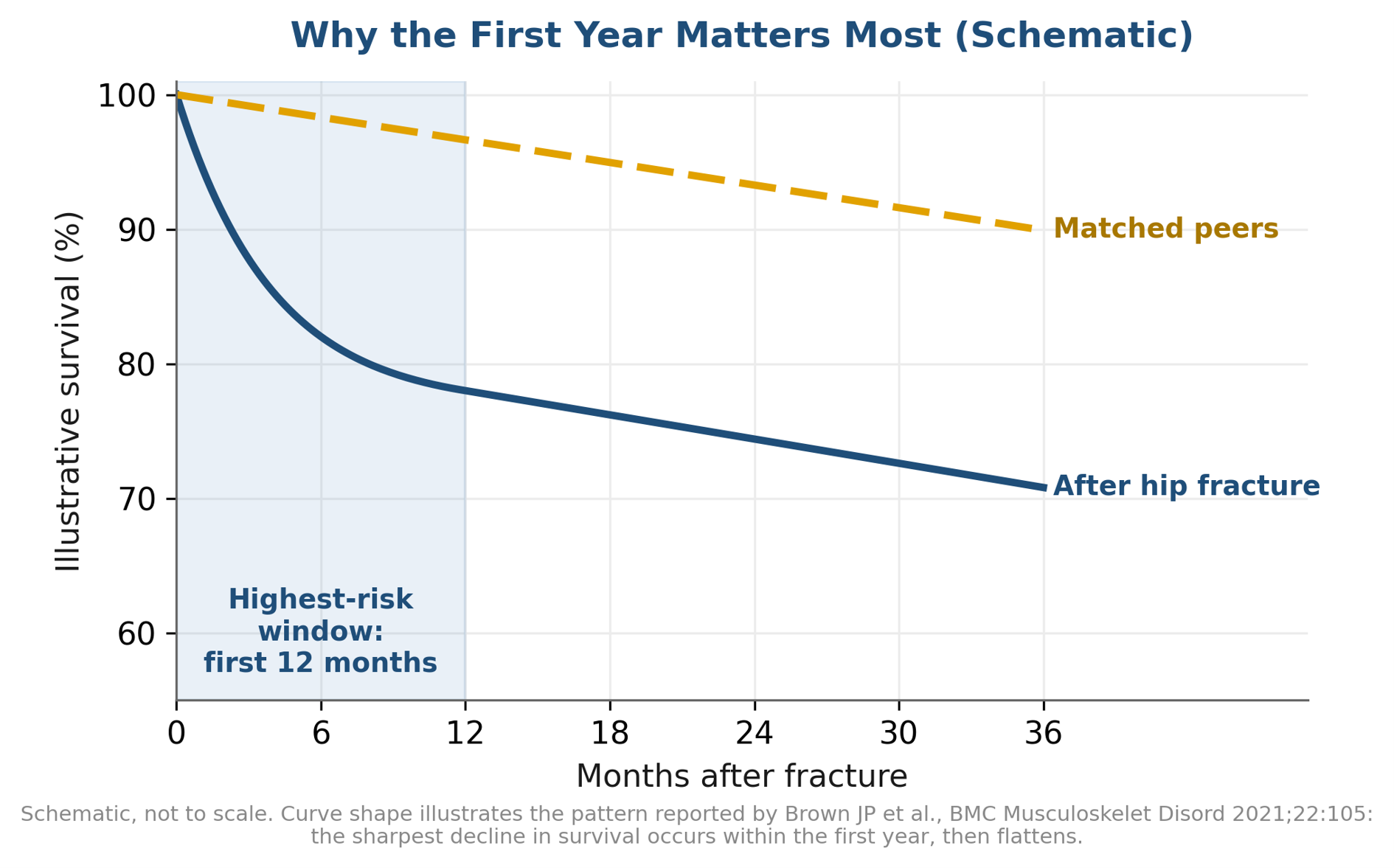
Figure 3. Survival declines most steeply in the first year after a hip fracture, then flattens. The first twelve months are the highest-risk window and the best opportunity for intervention.
Bone specialists describe a related idea called imminent risk: the one to two years right after a fracture are when the next fracture is most likely, which is exactly why early treatment of bone health matters so much.1,14 For families, this reframes recovery. The months right after a fall are not only about healing one injury. They are the time to lower the odds of the next one.
What helps a senior recover and live longer after a fall?
Much of what determines recovery can be influenced, which is the most important message in this article. Researchers separate the factors into those that cannot be changed, such as older age, being male, and prior fractures, and those that can be changed, the modifiable factors: bone health, medications that raise fall or bleeding risk, body weight, and overall fitness.5 The modifiable list is where families and care teams have real leverage.
Fast, well-timed surgery
For hip fractures, timing of surgery is one of the strongest levers we can pull to protect long-term survival. Clinical guidance finds that operating within 24 to 48 hours of the fracture improves outcomes,5 which is one reason getting help quickly after a fall is so valuable. The sooner an injury is identified and treated, the sooner the clock on complications can be stopped.
Early movement and rehabilitation
Getting up and moving soon after surgery, followed by structured rehabilitation, consistently improves recovery and lowers the risk of complications.5 Recovery from a broken hip is measured in months, not weeks, and roughly half of previously independent patients regain their earlier level of function, which makes rehabilitation and support at home central to the outcome.5,15 Treating the underlying osteoporosis, which weakens bone and drives much of the fracture risk, lowers the chance of another break and, in a large trial, improved survival.16 Careful attention to delirium, a common and serious complication after hip surgery, further protects recovery.17
Why do the first hours and days after a fall matter?
The response in the first moments after a fall can shape everything that follows. When an older adult cannot get up and spends a long time on the floor, what clinicians call a long lie, before help arrives, the consequences add up quickly, including dehydration, pressure injuries, and a delay in treating the underlying injury.18 A faster response means faster diagnosis, faster pain relief, and, when surgery is needed, a better chance of meeting that early treatment window.
This is where a plan for getting help quickly earns its place in the home. A medical alert system with automatic fall detection can summon help even when an independent senior living on their own is unable to reach a phone, and understanding how these systems work helps families choose the right setup. The point is not fear. It is readiness, so that a fall becomes a manageable event rather than a turning point.
Expert Perspective: The Long Lie and Getting Back Up
“It’s understandable to worry about being stuck lying a long time on the ground if you fall and are unable to get up because, even if you’re not injured, if you can’t call for help or have to wait ages for help to arrive, some potentially serious problems can develop, such as hypothermia, dehydration, muscle and tissue damage from pressure injuries and of course the psychological effects. But learning how to get up off the floor — and keeping practising getting down and back up again — can reduce the fear of falling and ‘long lies’, and exercises to improve strength and balance help to reduce the chances of falling.”
— Jane Fleming, PhD, Cambridge Public Health, University of Cambridge
How can families lower the risks and protect independence?
The same steps that reduce the chance of a fall also improve the odds of a strong recovery if one happens. Staying physically active builds the strength and balance that prevent falls and speed healing. A yearly medication review with a doctor or pharmacist (the senior’s healthcare team) can remove or adjust drugs that cause dizziness or raise bleeding risk. Simple home changes, such as better lighting, grab bars, and clear walking paths, remove common hazards. Regular eye checks and supportive footwear help too.
Preparation completes the picture. Knowing what to do after a fall, keeping a way to call for help within reach, and choosing a device that fits daily life all turn a frightening possibility into something a family can handle with confidence. Medical Guardian offers in-home and on-the-go medical alert options, and a quick look at how to choose and what it costs makes the decision easier. A fall does not have to be the end of independent living. With the right knowledge and a plan in place, most seniors keep doing the things they love, ready for whatever comes next.
Frequently Asked Questions
What is the life expectancy after a fall in seniors?
Most falls do not shorten life expectancy. The risk rises mainly when a fall causes a serious injury, especially a hip fracture, after which roughly one in five to one in three older adults dies within a year. Many people recover well, and fast treatment and good rehabilitation improve the odds.
What percentage of seniors die within a year of a hip fracture?
Studies generally report one-year mortality between about 20 and 30 percent, with higher rates in men. One large real-world study found about 21.5 percent in women and 32.3 percent in men, while a clinical review cites figures reaching 30 percent.
Why are hip fractures so dangerous for older adults?
The danger comes less from the broken bone than from the immobility that follows. Reduced movement after surgery raises the risk of blood clots, pneumonia, muscle loss, and confusion, and these complications drive most of the added risk.
How long does it take to recover from a broken hip?
Recovery is usually measured in months rather than weeks. Many people make meaningful progress within three to six months, and about half of those who were independent beforehand regain their earlier level of function. Early movement and structured rehabilitation help the most.
Can a senior fully recover after a fall?
Yes, many do. Most falls cause no lasting harm, and even after a serious injury a large share of older adults return to active, independent lives, particularly with prompt treatment, rehabilitation, and support at home.
Does a broken wrist or arm carry the same risk as a hip fracture?
No. A wrist or upper-arm fracture carries a much lower risk to life than a hip fracture. It is still worth taking seriously, because it often signals weakened bones and a higher chance of a more serious fracture later.
Why is the first year after a fracture the most important?
Survival declines most sharply in the first twelve months after a serious fracture, then levels off. That window is when complications and loss of independence do the most damage, and when good care makes the biggest difference.
What increases the chance of recovery after a fall?
Surgery within 24 to 48 hours when needed, early movement, structured rehabilitation, treatment of osteoporosis, and careful management of other health conditions all improve recovery. Getting help quickly after a fall supports every one of these.
Are falls without injury still a warning sign?
Yes. A fall, even one without injury, is one of the strongest predictors of a future fracture. It is best seen as an early signal and a chance to strengthen bones, review medications, and address the causes before a more serious fall.
What should I do right after a senior falls?
Stay calm, check for injuries, and do not rush to move them if there is severe pain or a possible head injury; call for medical help instead. Having a way to summon help quickly, such as a medical alert system with fall detection, means help arrives sooner, which can shape the entire recovery.
Is a hip fracture worse than a hip replacement?
They are different things, which is why the comparison can be confusing. A hip fracture is an unplanned break, usually from a fall, while a hip replacement is a planned surgery often used to repair the joint, sometimes after a fracture. The fracture itself is the dangerous event: in a frail older adult it carries a far higher risk of complications and death than a well-prepared, elective replacement. The goal after a fracture is fast, well-timed surgery and steady rehabilitation.
What is the 30-day mortality rate after a hip fracture?
Across studies, roughly 5 to 10 percent of older adults die within 30 days of a hip fracture, though the figure depends on age, sex, and other health conditions. Men and the oldest patients tend to face higher short-term risk. The first weeks are a high-risk window, which is why prompt surgery and close medical care matter so much.
What is the lifetime risk of breaking a hip?
It is higher than many people expect. From age 50, the remaining lifetime risk of a hip fracture is on the order of 1 in 6 for women and about 1 in 20 for men, though estimates vary by country and population. The gap reflects the faster bone loss many women experience after menopause. Strong bones, good balance, and a safe home all help bring that risk down.
What is the most common cause of a hip fracture in seniors?
Falls. The large majority of hip fractures in older adults happen because of a fall, often a low-energy fall from standing height onto a hard surface. Weakened bone from osteoporosis makes these everyday falls far more likely to break a hip. The national figures are available in the CDC falls data.
Does age affect life expectancy after a fall?
Yes. Older age is one of the strongest factors in how a fall affects survival, both because serious injuries like hip fractures become more common and because recovery is harder. One-year mortality after a hip fracture climbs steadily with age, from a few percent in people in their early 50s to roughly a third in those in their 90s. Age cannot be changed, but bone health, fitness, and fast help after a fall all can be.
When should a senior who has fallen go to the emergency room?
Seek emergency care if the person hit their head, lost consciousness, cannot bear weight or move a limb, has severe pain, or takes a blood thinner, since these can point to a fracture or bleeding that is not obvious at first. New confusion, repeated vomiting, or a severe headache after a fall also call for urgent evaluation. When in doubt, getting checked is the safe choice. Understanding how a medical alert system works can help a senior summon help quickly when a fall happens.
Why do doctors ask whether you have fallen in the past year?
Because a previous fall is one of the strongest predictors of a future fall and fracture, even apart from bone density. The question is part of routine fall-risk screening, and it lets a clinician review medications, check balance and vision, and suggest changes before a more serious fall happens. A single fall is a signal to act, not a reason to lose confidence. Automatic fall detection can add a layer of protection while those steps take effect.
Can vitamin D and calcium lower the risk of a hip fracture?
They can help, especially for older adults who are low in these nutrients or living in residential care, where adequate calcium and vitamin D together have been shown to modestly reduce hip fractures. The benefit is less clear for healthy, well-nourished seniors, and supplements do not replace treating osteoporosis when it is present. Ask a doctor before starting, since the right amount depends on diet, sunlight, and other conditions.
References
- Hoong, C. W. S., Saul, D., Khosla, S. & Sfeir, J. G. Advances in the management of osteoporosis. BMJ 390, (2025).
- Brown, J. P. et al. Mortality in older adults following a fragility fracture: real-world retrospective matched-cohort study in Ontario. BMC Musculoskelet. Disord. 22, 105 (2021).
- Facts About Falls | Older Adult Fall Prevention | CDC. https://www.cdc.gov/falls/data-research/facts-stats/.
- Grigoryan, K. V., Javedan, H. & Rudolph, J. L. Orthogeriatric care models and outcomes in hip fracture patients: A systematic review and meta-analysis. J. Orthop. Trauma 28, (2014).
- Schroeder, J. D., Turner, S. P. & Buck, E. Hip Fractures: Diagnosis and Management. Am. Fam. Physician 106, 675–683 (2022).
- Ghafarian, A. M., Wajahath, M., McBee, K., Nasser, E. & Ghali, A. One-year mortality after first-time long bone fractures in older adults: A multicenter retrospective cohort study. Injury 57, (2026).
- Lotti, F. et al. Impact of anticoagulants in elderly patients who suffer a hip fracture. Should we have a different approach? Acta Bio Medica : Atenei Parmensis 91, e2020108 (2020).
- You, D. et al. Effect of oral anticoagulant use on surgical delay and mortality in hip fracture. Bone Joint J. 103-B, 222–233 (2021).
- de Wit, K. et al. Clinical Predictors of Intracranial Bleeding in Older Adults Who Have Fallen: A Cohort Study. J. Am. Geriatr. Soc. 68, 970–976 (2020).
- Dubucs, X. et al. Risk Factors for Traumatic Intracranial Hemorrhage in Older Adults Sustaining a Head Injury in Ground-Level Falls: A Systematic Review and Meta-analysis. Ann. Emerg. Med. 87, 181–191 (2026).
- Vedin, T. et al. Antiplatelet therapy contributes to a higher risk of traumatic intracranial hemorrhage compared to anticoagulation therapy in ground-level falls: a single-center retrospective study. Eur. J. Trauma Emerg. Surg. 48, 4909–4917 (2022).
- Kulkarni, R. S., Kulkarni, R. R., Kulkarni, R. R. & Kulkarni, S. R. R. Distal radius fracture, a predecessor to hip fracture in osteoporotic elderlies: not just a notion but a codified itinerary-Long term follow up study of 30 years (1985-2015). Eur. J. Orthop. Surg. Traumatol. 35, 294 (2025).
- Vandenput, L. et al. A meta-analysis of previous falls and subsequent fracture risk in cohort studies. Osteoporosis International 35, 469–494 (2024).
- Johansson, H. et al. Imminent risk of fracture after fracture. Osteoporos. Int. 28, 775–780 (2017).
- Dyer, S. M. et al. A critical review of the long-term disability outcomes following hip fracture. BMC Geriatr. 16, (2016).
- Lyles, K. W. et al. Zoledronic acid and clinical fractures and mortality after hip fracture. N. Engl. J. Med. 357, 1799–1809 (2007).
- Marcantonio, E. R., Flacker, J. M., Wright, R. J. & Resnick, N. M. Reducing delirium after hip fracture: a randomized trial. J. Am. Geriatr. Soc. 49, 516–522 (2001).
- Kubitza, J., Schneider, I. T. & Reuschenbach, B. Concept of the term long lie: a scoping review. Eur. Rev. Aging Phys. Act. 20, (2023).