Quick Summary
Automatic fall detection exists because the alert button often goes unpressed. A year-long Cambridge University study followed people aged over 90. In 99% of falls where someone was alone and could not get up, a call-alarm system was installed. It was not used in 80% of those falls.1 A fall detector takes that step away from the user. A motion sensor reads the body dozens of times a second. Software then checks that stream for one sequence: a drop, an impact, a change in posture, followed by stillness. If the sequence appears, a monitoring center is automatically called without anyone pressing anything. The catch is that the sequence is far cleaner in a lab than on a kitchen floor. Pooled across 80 published studies, performance sits near 90%. Tested against 29 real falls, 13 published methods caught 57% of them on average. That gap between roughly 90% in the published literature and 57% on real falls is the single most useful thing on this page, and it exists because a real fall in a real home rarely produces the clean signal those methods were tuned on.1–3 This guide covers what the sensors measure, how the call is made, and what that gap means in practice.
Medical Disclaimer: This article is for general education and is not medical advice, a diagnosis, or a treatment recommendation. Fall risk is individual. Talk with a physician, physical therapist, or pharmacist about your own risk factors and about any device you are considering as part of a safety plan.
On this page:
- What fall detection is
- Why it was invented
- Wearable sensors
- Where to wear it
- What a fall looks like to a sensor
- In-home sensors
- How the algorithm decides
- Device or cloud
- What happens next
- How accurate it is
- Why falls get missed
- Why false alarms happen
- What comes next
- FAQ
- References
What is fall detection, and how is it different from a help button?
Fall detection is the part of a medical alert system that raises an alarm without the person falling doing anything. In contrast, a help button waits for a deliberate press. A fall detector monitors motion continuously, decides on its own that a fall has occurred, and starts the call for help by itself.
Fall detection is designed as an addition to a help button rather than a replacement for it, because a person can need help for reasons that have nothing to do with falling. What the automatic layer adds, is coverage for the specific case where the person cannot press anything at all: they are unconscious, they are disoriented, they cannot reach the pendant, or they have decided not to call. Researchers usually describe that layer as a passive layer, meaning one that works without the person doing anything, as opposed to the active alert a button provides.4
Most fall detection systems work through the same four stages:4
- A sensor measures something physical.
- A processor turns that measurement into a small set of numbers.
- A rule or a trained model compares those numbers against what a fall is expected to look like.
- If the comparison deems that a fall has occurred, the system triggers an alert.
Two words in the third stage are worth pinning down, because the rest of this guide turns on the difference. A rule is a fixed cut-off written by an engineer. For example, treating any impact above a set force as a fall if the person is still on the floor for a predetermined amount of time later. A trained model is never given a cut-off. It is shown thousands of recorded movements that have already been labeled as falls or not falls, and it works out the pattern for itself. The sections below take each stage in turn.
Why was automatic fall detection invented?
The clearest answer comes from a study that was not about technology at all. Researchers led by Dr Jane Fleming, running the Cambridge City over-75s Cohort study in the Department of Public Health and Primary Care at the University of Cambridge, followed 110 Cambridge residents aged over 90 for a year, recording the circumstances of every fall. That cohort ran from 1985 to 2015 and is one of the largest and longest-running population-based studies of the oldest old anywhere, which is why a single year of its falls data carries as much weight as it does.1 They logged 265 total falls in 66 people. In 82% of them (217 of 265) the person was alone. Of the 66 people who fell, 80% (53 of 66) were unable to get up on their own after at least one fall, and 30% (20 of 66) spent an hour or more on the floor.
The alarm data is what makes this study matter for fall detection. Among falls where the person was alone and could not get up, 99% of the time they already had some form of a call alarm system installed. In 80% of those falls, they did not use it. Of the falls that turned into a long time on the floor despite an alarm being present, 97% involved an alarm that was never activated.1
The reasons these participants gave for not using their alarms were human rather than technical. They described taking the pendant off before bed, hanging it on a chair, deciding they would rather get up unassisted, or worrying that pressing it would land them in hospital. The authors concluded that automatic fall detectors that do not depend on the wearer activating them could reduce time on the floor for this group.
That time on the floor is the outcome the technology is aimed at. A prolonged period on the ground, often called a long lie, is associated with pressure injuries, dehydration, hypothermia, and pneumonia, and it makes a hospital stay and a later move into long-term care more likely.1 In 2023, a German nursing-science group pooled the results of 22 separate studies on this, in what researchers call a scoping review. Between them those studies covered 6,311 people, of whom 2,805 (44%) could not get up after a fall and 1,121 (18%) went on to a long lie. Within a year, between 29% and 77% of the people who had a long lie moved into a long-term care facility, and their mortality was higher than for people who fell without one. That range (29%-77%) is wide for a reason worth knowing: the studies behind it did not agree on what counts as a long lie. Thresholds differed from study to study, so it cannot be assumed that the people in them spent comparable time on the ground. The low end traces back to the Cambridge cohort above, which counted an hour or more on the floor as a long lie; the high end comes from a 1996 study of people found helpless in their own homes for 72 hours or more, a far more severe group by definition.5 The same pooled work found that 78% of people aged 65 and over who fall need help getting back up off the floor, and that those who do get help typically wait between nine and twenty minutes for it.6–8
Falls themselves are common enough to make this a mainstream design problem rather than an edge case. In the United States, as of 2026 about 14 million adults aged 65 and older, roughly one in four, report falling in a given year, according to CDC surveillance data on older adult falls.9
Which sensors do wearable fall detectors use?
Three words come up constantly from here on, and they are worth fixing in place now. Sensitivity is the share of real falls a system catches. Specificity is the share of everything else that it correctly ignores. Accuracy combines the two, which is why a system can post a high accuracy figure while missing a great many falls. Wearable systems lead both the research and the market. The most recent pooled analysis of the field, a 2025 review of 80 separate studies, found that 43 used wearable sensors. Accelerometers appeared in 86% of those, and gyroscopes in around 35%.2 Here is what each part does.
Accelerometer
A triaxial accelerometer measures acceleration along three axes at right angles to each other: side to side (X-axis), forward and back (Y-axis), and up and down (Z-axis). Gravity registers as acceleration too, so the same chip reports which way is down when the device is still. That is why one part can supply both the impact peak and the posture check after it.
Range matters more than the spec sheet suggests. Every accelerometer has a ceiling, and one rated to 2 g cannot report anything above 2 g. A harder impact is still recorded as exactly 2 g, so the sharp peak the rules are looking for arrives flattened into a plateau, and a real fall can read like a moderate bump.3
Gyroscope
Unlike an accelerometer which measures linear acceleration, a gyroscope measures rotational velocity and twisting movement – how fast the device is turning. A fall tips the torso over fast and without control. Sitting down and lying down rotate it slowly and deliberately. That difference is what a gyroscope adds: it separates a genuine fall from a controlled change of posture that happened to produce a similar thump. This is the argument for carrying both sensors rather than an accelerometer alone. A fall produces high acceleration and high rotation at the same time, and ordinary daily activity does not produce that combination. In one study, 36 volunteers performed 702 separate movements while wearing both sensors; combining the two and tuning the thresholds reached 96.3% sensitivity and 96.2% specificity, with the gyroscope doing the work of telling a real fall from vigorous ordinary activity.4,10 Not every product carries one, for two reasons. A gyroscope costs more battery than an accelerometer, because it has to keep a tiny mass vibrating continuously in order to sense rotation at all, while an accelerometer only has to read a mass that sits still until something moves it. And the gain is not automatic: a 2020 study that fed accelerometer and gyroscope data to the same neural network found the gyroscope improved detection in some configurations and not others, depending on the classifier and the features used.11

Figure 1. Both sensors sit in the same chip and read the same three axes differently. a. An accelerometer measures movement along each axis: X side to side, Y forward and back, Z up and down. Because gravity registers as acceleration, a still device still reports which way is down. b. A gyroscope measures rotation about those same axes, named yaw, roll and pitch. A fall tips the body over quickly and without control; sitting and lying down turn it slowly and deliberately.
Source: Original figure. Schematic, drawn for this article.
Barometric pressure sensor
A barometer measures air pressure, which falls predictably with altitude. Over the height of a human body the difference is small but real: air is very slightly denser at floor level than at waist height, so a sudden rise in pressure means the sensor has moved down. Paired with an accelerometer, it gives a detector a second and independent way of telling that someone is now on the ground rather than sitting down.4 It is a partial answer to the hardest problem in the field, which is telling a fall apart from lying down deliberately. Its weakness is that weather systems, elevators, and opening a door all move air pressure too, so it is used as a supporting signal rather than a primary one.
Where on the body should the sensor sit?
Placement changes performance more than most buyers would expect. The most thorough test of this, published in 2016, ran 2,520 recorded movements past sensors worn at six places on the body at once: head, chest, waist, wrist, thigh and ankle. Every combination of those positions was then run through six different classification methods, 378 combinations in all. The waist came out best, catching 99.96% of falls. The wrist came out worst of the six, at 97.37%, and the author noted the awkwardness of that result directly: the wrist is the location wearable devices actually use.12
That finding sits awkwardly next to a fact about people. The wrist is the spot people actually keep a device on. This is the central trade-off in the category. The most accurate spot is not the most worn spot, and a detector left on the nightstand catches nothing at all. Most products accept some loss of signal quality to gain daily wear. Given how often an alarm within reach goes unpressed, that is a sensible trade.1
What does a fall look like to a sensor?
A fall detector never sees a person falling. It sees a stream of numbers: readings on each of the three axes described above, arriving somewhere between 20 and 200 times a second. It has to recognize a pattern inside that stream. Understanding the pattern is the key to understanding both why detection works and where it breaks.
The four phases of a fall
Research on fall detection generally divides a fall into four phases. The framework comes from a 2007 paper by Norbert Noury, a biomedical engineer who spent his career building health-monitoring systems for the home, first at the University of Grenoble and later at the University of Lyon. His four-phase description is now used almost universally.13,14
- Pre-fall. Ordinary activity, then the loss of balance. A stumble that gets caught and a stumble that becomes a fall look much the same at this point, which is why the devices you can buy wait rather than act here. Predicting the fall inside this window, before the body reaches the ground, is an active research problem rather than a feature of anything on sale.
- Critical phase. The body accelerates toward the ground. This is the shortest phase, lasting roughly 300 to 500 milliseconds, and it ends at impact.4
- Post-fall. The person is on the ground, usually with very little movement and a body orientation that has changed sharply from before.
- Recovery. The person gets up, with or without help, or does not.

Figure 2. The four phases of a fall as a motion sensor records them, measured in g, where 1 g is the reading a still device gives under normal gravity. The reading rises and falls with ordinary activity, drops toward zero as the body begins to fall, spikes when the body hits the floor, then returns to its resting level and goes still. Movement only resumes if the person gets up. The critical phase, from the loss of balance to the impact, is the shortest of the four at roughly 300 to 500 milliseconds; it is drawn here at the top of that range. Stillness is what the sensor sees after a fall; whether the body is upright is a separate reading. A detector that reacts to the spike alone fires when someone sits down hard, so requiring the drop, the spike and the stillness in order is what separates a fall from ordinary movement.
Source: Schematic. Phase framework from Noury et al. 2007; impact magnitude range from Pannurat et al. 2014.
Detectors differ in which phases they use. The simplest look only at the critical phase, the impact itself, which is a weak basis for a decision because sitting down heavily produces an impact too. Better ones require the critical phase and the post-fall phase to agree: something hit the floor, and it is still there. An impact on its own is ambiguous, and what happens in the seconds after it is what separates a fall from sitting down hard.
How do fall detection systems you do not wear work?
Room-based systems put the sensor in the home instead of on the person. Nothing has to be charged, remembered, or worn. Room-based and hybrid systems reported higher average accuracy and sensitivity than wearable systems, but differences in specificity were not statistically significant.2
Cameras and depth sensors
A camera system tracks the outline of a person. It watches for the shape and speed changes that mark a fall. The outline goes from tall to wide. The downward speed spikes. The body then stays flat. Depth cameras made this far more reliable, because they report distance for every pixel and so, remove much of the confusion that lighting creates.4 One depth-camera system was tested across 13 apartments over roughly 3,339 days of continuous recording. It captured 454 falls, of which nine were real rather than acted. That ratio is the problem the whole field has: even in one of the longest live deployments on record, genuine falls are rare enough that nearly everything a system learns from is staged.4
Cameras are the most capable single room sensor and the least welcome one. Four limits have followed them since 1991: field of view limitations, lighting, which can at times be poor, camera positioning, which may not always be optimal, and the fact that they record people inside their own homes, which raises privacy concerns.2,4
Expert Perspective: Why Depth Sensing
“Considering all of the different fall detection sensing modalities we have studied, my favorite is depth sensing because (1) it preserves privacy, (2) it produces accurate results even in dark conditions, (3) it can capture what happened leading up to the fall, which provides an opportunity to identify and alleviate hazards, and (4) the same depth sensor can be used to measure natural walking gait, which provides a measure of fall risk.”
— Marjorie Skubic, PhD, Curators’ Distinguished Professor Emerita, EECS Dept., University of Missouri; NSF IUCRC Center to Stream Healthcare In Place (C2SHIP)
Radar and radio sensing
Radar answers the privacy objection head on. A small unit sends out a low-power radio signal and measures the faint reflections that come back off anything moving in the room, in the same way a bat locates a moth. From those reflections it builds a rough cloud of moving points and a speed for each of them, worked out from how much the returning signal is stretched or squeezed by the movement. That second part is the useful one: a body dropping to the floor moves toward the ground far faster than a person sitting down does. It records no image and no sound. It works in the dark. It sees through steam. That is what makes bathrooms and bedrooms workable. Reported accuracy for radar is among the highest of any room sensor.2
Related work uses ordinary Wi-Fi. A human body disturbs the radio signal running between a router and a device. Those disturbances can be sorted into activities, falls included, with no extra sensor in the room.2 Radar and Wi-Fi sensing are both tied to the space they were set up in. Both also degrade when more than one person is moving in the room, because the signal they read is the sum of everyone in it. That makes these systems a much better fit for someone living alone than for a couple, and it is worth asking about before installing one.
Floor vibration and pressure sensors
A body hitting the floor makes a low, heavy vibration. A dropped book or a closing door makes one too, but a lighter and higher-pitched one, and the difference is large enough to sort by. Sensors fixed to the floor pick that difference up. Nothing is worn and nothing is recorded, so privacy is not an issue. The catch is that the signal depends on how the building is built. It is also the least accurate of the room-based options in testing.2 Pressure mats and pressure-sensing floor panels have also been tested.4
Acoustic sensors
A set of microphones can hear an impact. Because the microphones can also estimate the height a sound came from, it can tell a body hitting the floor from a book sliding off a table.2 Background noise, televisions, and pets are the practical limits. A live microphone in the home also raises the same privacy questions as a camera.
Infrared and thermal sensors
A low-resolution heat sensor makes a rough heat map of a room. It is the same basic idea as the thermal cameras firefighters use to find people through smoke, scaled down until it can no longer show a face, often a grid of only a few dozen squares. That is enough to find a warm body and see whether it has dropped to floor level. It is far too coarse to identify anyone, which is exactly why it gets used. A heat sensor can tell that a warm shape is now lying on the bathroom floor without producing anything that could be recognized as a person, which is the one place a camera cannot go. Motion sensors of the kind used in burglar alarms play a supporting role too. A fall followed by a long stretch of no movement is treated differently from a fall followed by normal activity.2,4,15
Worn devices and room-based sensors both work, and neither is better in the abstract. They fail in different ways, and the failures land differently depending on the person. A worn device fails when it is not worn, which makes it the wrong answer for someone who will not keep it on. A room sensor fails when the person walks out of the room it covers, which makes it the wrong answer for someone still out most of the day. Matching the failure you can live with to the life the person actually leads is the whole decision.
How does the algorithm decide that a fall happened?
The sensor supplies numbers. The algorithm supplies the verdict. Published approaches fall into three families, and the differences between them show up directly in how a device behaves in a home.
Threshold rules
The simplest method compares one number against one fixed cut-off. If that combined reading goes above the line, call it a fall. This costs almost nothing to run. It works on a chip powered by a watch battery. And anyone can read the rule and see what it does.
Its weakness is that one number has to fit everyone. A cut-off set on healthy volunteers falling onto a crash mat may not fit a frail 88-year-old folding sideways against a sofa. Across the 80 studies pooled to date, the cut-off itself is named as the main limit of this approach. It is too sensitive to differences between people and to where the sensor sits.2
Rule chains
Products sold today generally use a chain rather than a single test: free-fall trough, then impact peak within a time limit, then a posture check a second or two later, and only then an alert.3
The cost runs in the opposite direction. Every added condition is another chance for a genuine fall to fail one test and go unreported. The trade-off is stated plainly in the literature: the more conditions an algorithm imposes, the more assumptions a real fall has to satisfy, and the less likely it is to be caught at all.3
Machine learning
Here an engineer no longer picks the cut-off. A model learns it from labeled examples. Five types come up most often: decision trees, which sort an event by asking a series of yes-or-no questions; nearest-neighbor methods, which compare a new event against the most similar recorded ones; support vector machines, which draw the dividing line between falls and non-falls as far from both as possible; naive Bayes, which weighs up how likely each reading is under each answer; and artificial neural networks, which are the simple ancestors of the deep models below.2 The engineer still picks what the model gets to see. That short list is usually the average, the spread, the combined reading across the three axes, and the tilt angle.4
Across the pooled studies, this family scored lowest of the four on both accuracy and specificity.2 Learning a cut-off is not always better than knowing where to put one. That is doubly true when the training set is small.
Deep learning
Deep learning is a branch of machine learning rather than a rival to it. What sets it apart is that the hand-picked measurements go away: the model is given the raw signal and works out for itself which parts of it matter. A handful of architectures dominate the literature. Convolutional neural networks (CNN) pick out local shapes in the trace, much as they pick out edges in a photograph. Long short-term memory (LSTM) networks and recurrent neural networks (RNN) track how a signal changes over time, which suits an event defined by a sequence. Gated recurrent units (GRU) do the same job with fewer moving parts. Auto-encoders take a different route: they learn what ordinary movement looks like and flag whatever departs from it. In practice it is CNNs, LSTMs, GRUs and combinations of them that get used most, and on average this family produces the best results of any.2
Deep learning produced the best results of the four families on every performance measure the pooled studies were scored against.2 The costs are more training data, more computing, and a model with multiple parameters that nobody can read the way they can read a simple rule.
Sensor fusion
Fusion weighs more than one sensor before deciding. A system might use a worn motion sensor to flag a possible fall cheaply, then wake a depth camera to confirm it. That combination tests better than either half alone.2 The price is complexity, setup, and cost. It also adds a new way to fail. A hybrid system has two halves: one worn on the body, one installed in the room. The worn half is usually what tells the room sensor to start looking, so left on the dresser it takes the whole system down with it.
Does the thinking happen on the device or in the cloud?
Where the math runs is a design choice the buyer feels. Running it on the device keeps raw motion data on the pendant or watch. It also works when the network is down, and it answers with no network delay. The limits are battery and chip speed. Software on the device can still be updated over the air, so that is not the real difference. Running it in the cloud allows models far larger than a pendant could hold, and lets them be retrained on data from every user at once. The costs are sending data off the device and depending on a connection. Many systems split the work. A cheap first pass on the device decides whether anything is worth sending, and a bigger model reviews it afterward. That first pass is not always a simple rule. A 2024 wearable prototype ran a trained model on the device itself, on a chip drawing so little power that the sensor could stay on continuously,16 so the split is increasingly between a small model on the body and a larger one in the cloud rather than between a rule and a model.
What happens in the seconds and minutes after a fall is detected?
Detection is the beginning of the response, not the end of it. The sequence in a monitored system runs roughly as follows.
- Confirmation. Many devices wait a short interval and re-check posture and movement before doing anything, which is the oldest idea in automatic fall detection and still the most useful one.17
- Cancel window. The device signals that it is about to call, usually with sound, light, and vibration, and offers a way to stop it. This is how a system absorbs its own false positives without involving anyone else.
- Connection. If the alert is not canceled, the device contacts a monitoring center over cellular or landline. Two-way voice lets an operator speak to the person through the device itself, which is standard on in-home base units and on mobile buttons alike.
- Location. Mobile units transmit GPS coordinates so responders can find someone who fell away from home. In-home units report the address on file.
- Escalation. The operator follows a documented order: speak to the person, dispatch emergency services if there is no response or if help is needed, then notify family contacts.
- Follow-up. The event is logged. Repeated detections over time are themselves clinically informative, and logging minor falls as risk data is an idea as old as the first working detectors.17
The cancel window is the one setting in that sequence a buyer can actually ask about, and it is short by necessity. Make it long and a genuinely unconscious person waits longer for much needed help. Make it too short and users cannot cancel in time. Our overview of how medical alert systems work end to end walks through the monitoring side in more detail.
How accurate is fall detection?
Two bodies of evidence answer this, and they do not agree.
What the pooled literature reports
Researchers in 2025 screened 473 records and analyzed 80 studies of fall detection in the home.2 They pulled out more than 400 accuracy values. Averaged across studies, worn sensors reached 91.1% accuracy, 87.5% sensitivity, and 90.2% specificity. Room sensors reached 92.6%, 89.2%, and 93.7%. Systems that used both reached 94.6%, 97.6%, and 92.8%. One detail in those figures is easy to misread. The accuracy and sensitivity differences between the three held up when the authors tested them statistically; the specificity differences did not, so the three specificity values should be read as the same number rather than as room sensors beating the others. That fits how the sensors work. Adding a second mode gives a system more chances to catch a fall, which is why sensitivity climbs to 97.6%, and more chances to fire at something that is not one, which is why specificity does not move. Combining modes buys you fewer missed falls, not fewer false alarms. Sorted by method rather than by sensor, the same pool put classical machine learning last, at 88.2% accuracy and 86.2% specificity, and deep learning first, at 93.7% on both.
Those numbers look reassuring. The authors are careful to say why they should not be read as field performance. About 64% of the methods were tested on data the same team built. Most of that data comes from staged falls, and the conclusion drawn is that testing needs to move onto real falls before these numbers mean much.2
Expert Perspective: Why the Evidence Lags the Technology
“Fall-detection technology has advanced considerably since our original study, but the evidence base has not advanced at the same pace. We still lack large, shared datasets of genuine falls that allow algorithms to be independently tested across different populations and real-world settings.”
— Lorenzo Chiari, PhD, Professor of Biomedical Engineering, Department of Electrical, Electronic and Information Engineering, University of Bologna
What happens on real falls
One study tested that directly. A group at the University of Bologna took 13 published methods in 2012 and ran them against 29 real falls. The falls were recorded on patients at high risk of falling, during ordinary daily life.3 That benchmark has been built on rather than overturned. In 2020 the same group trained and tested machine learning methods on 143 real-world falls from the FARSEEING repository, the largest such collection assembled, and found that algorithms learn better from features drawn from a multiphase model of a fall than from conventional ones. The same study also found that a method which had done well on one set of real falls performed substantially worse on a different real-world dataset, which is a caution against reading any single result as settled.18
Average sensitivity across the 13 methods was 57.0%. The spread was wide, and the best single result was 82.8%. Average specificity was 83.0%. The best balance came from a method that had scored 100% on both measures when it was tested on staged falls. Run against the real ones, the same method managed 83% sensitivity and 97% specificity, so it missed roughly one fall in six. One further number is worth separating out carefully, because it is easy to misread. The 29 falls were recorded inside long stretches of ordinary daily life, and the algorithms were run across all of it, not only across the falls. Counting every alert they raised across that whole recording, fewer than one in five landed on a real fall. The falls were genuine; most of the alerts were not.
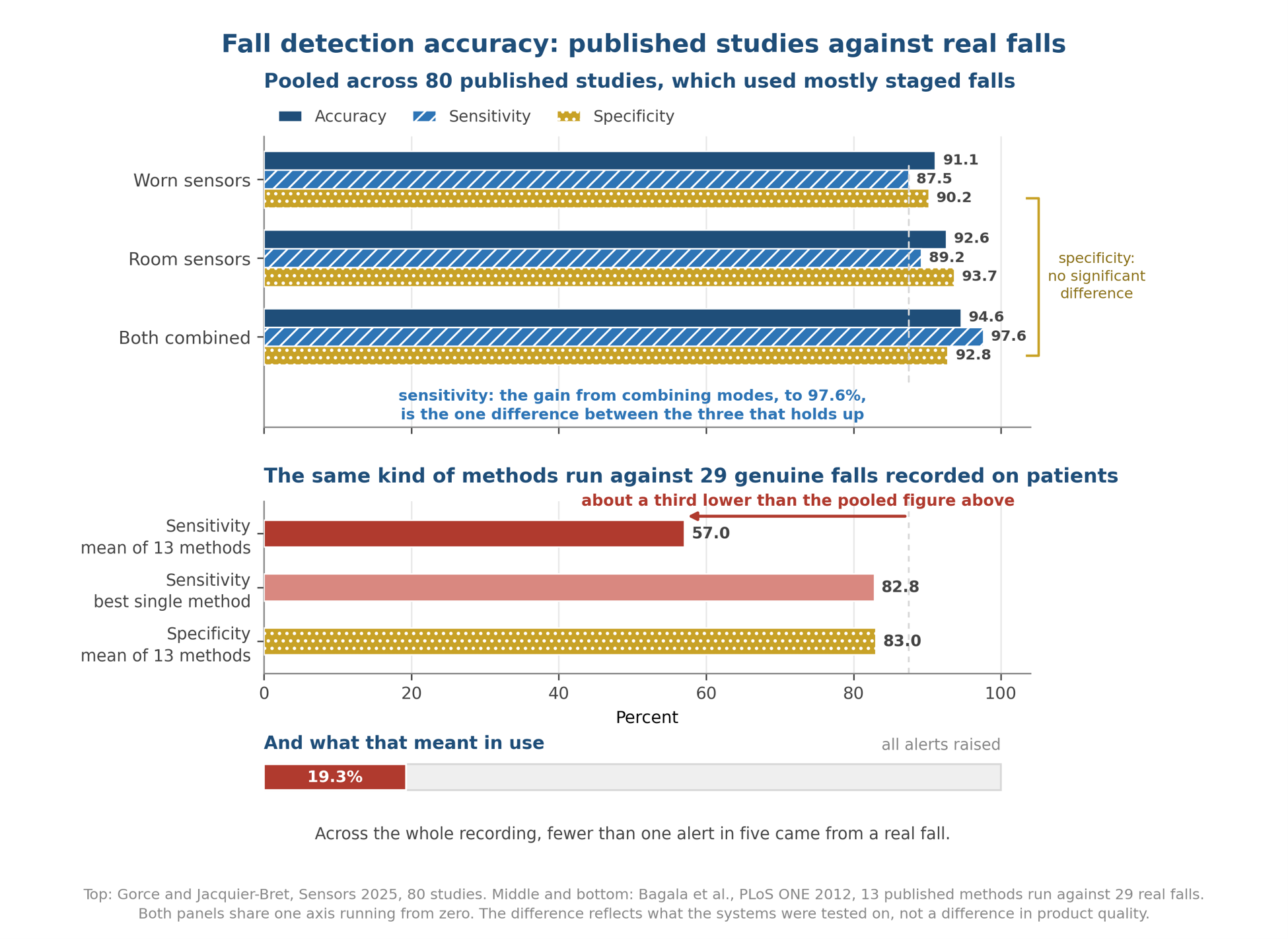
Figure 3. Top: mean accuracy, sensitivity and specificity by sensor category, pooled across 80 studies that used mostly staged falls. Middle: the same kind of methods run against 29 genuine falls recorded on patients, with sensitivity and specificity listed separately because they are different measures. The bracket marks the three specificity values, whose differences were not statistically significant. The note beneath marks the sensitivity gain from combining modes, which was. Bottom: of every alert those methods raised across the whole recording, 19.3% came from a real fall. The two panels share one axis running from zero, so the pooled figures and the real-world figures are read against the same ruler. The difference reflects what the systems were tested on, not a difference in product quality.
Source: Original figure. Pooled values from Gorce & Jacquier-Bret 2025; real-world values from Bagala et al. 2012.
The reasons are specific rather than mysterious. Cut-offs set on volunteers falling onto mattresses do not carry over to older adults falling onto carpet, against a walker, or onto a bed. Many real falls never produce the free-fall dip the rules expect. Many never end with the person flat on the floor, so the posture check fails.
None of this means fall detection does not work. It means a fall detector is a second line of defense. It raises the odds of a fast response. It does not promise one. That is also the honest reason to keep the manual button, and to tell family that the device does not replace checking in.
Expert Perspective: What to Ask About an Accuracy Figure
“Consumers should look beyond a headline accuracy figure. They should ask whether a device was tested on genuine falls in real life, whether the results were independently validated, and how many false alarms it generates over a day or a week, because all of these determine how useful the system will actually be.”
— Lorenzo Chiari, PhD, Professor of Biomedical Engineering, Department of Electrical, Electronic and Information Engineering, University of Bologna
Why does a fall detector miss a fall?
Misses cluster into a handful of recognizable patterns, and knowing them tells you what a device is likely to catch.
- The fall was slow. Someone who feels themselves going and grabs at a counter descends gradually. Peak acceleration never reaches the impact threshold.
- The landing was soft. Falls onto a bed, a sofa, or a thick rug absorb the impact. Low-impact forward falls, falls onto a bed or sofa, and falls against a wall were the specific events the best-performing algorithm still missed in the real-world test.3
- The person did not end up flat. Falls onto the buttocks, onto the knees, or against furniture leave the trunk near vertical, so a posture rule that expects lying down rejects the event.3
- The device was in the wrong place. A pendant that has ridden up under a chin, or a watch on a hand that was outstretched to break the fall, records a different signal than the algorithm expects.
- The device was not being worn. A wearable fall detector cannot detect a fall when it is not on the person’s body.
The fall was not the kind the algorithm was built around. Detection rules are tuned on the falls researchers stage most often, which are falls from standing. A fall from a wheelchair, from a bed, or in any other position the rules do not model is a different event, and one a device may not register at all.
The practical implication is straightforward: the wearing habit does more for outcomes than any specification on the box. A device kept on in the bathroom and at night, where a large share of falls happen, will outperform a technically superior device left on a dresser.
One laboratory study of Apple Watch fall detection puts a number on that. Researchers tested the fall detection on an Apple Watch Series 5 against falls staged from a wheelchair, and the watch missed roughly 95% of them.19 The figure has since been repeated as though it described the watch in general, which is not what the study measured. We asked its first author how families should read it.
Expert Perspective: What One Widely Quoted Figure Does Not Mean
“We found that the Apple Watch Series 5 fall detection feature missed most of the wheelchair falls we tested among young, able-bodied adults. However, we cannot use these results to say how well it detects falls that happen while walking.”
— Libak Abou, PhD, Research Assistant Professor, Department of Physical Medicine and Rehabilitation, University of Michigan
Why does a fall detector raise a false alarm?
False alarms come from ordinary movements that happen to reproduce part of a fall’s signature. Sitting down heavily generates an impact peak. Dropping onto a bed or a chair produces brief weightlessness, which is exactly the trough some algorithms use to mark the start of a fall; this was identified as the reason one family of algorithms produced the worst specificity in the real-world test described earlier.3 Bending to pick something up, a pendant swinging against a table, setting a watch down hard, and rolling over in bed can all contribute.
The published numbers are worth seeing. Across 24-hour recordings from three participants, 13 tested algorithms produced between 3 and 85 false alarms per day depending on the algorithm.3 A separate long-term test of a vest-mounted detector logged 833 hours of monitoring in which no actual fall occurred and 42 false alarms did.3
This is not a minor annoyance. The main reason fall detection systems fail in service is that monitoring services reject them over false alarm rates.3 For the person wearing the device, repeated false alerts erode trust and lead to the device being switched off, which returns them to the situation the technology was built to solve.
Expert Perspective: Why Real-World Testing Matters
“The challenge in detecting falls in unstructured, real-world settings is avoiding false alarms. It is not good enough to detect all the falls if you also generate a large (sometimes very large) number of false alarms. If this happens, then the people getting the alarms will ignore them. We put fall detection systems in real apartments where older adults live so that we can study the types of false alarms generated and the false alarm rate.”
— Marjorie Skubic, PhD, Curators’ Distinguished Professor Emerita, EECS Dept., University of Missouri; NSF IUCRC Center to Stream Healthcare In Place (C2SHIP)
Rare events are unforgiving this way. Even 97% specificity adds up to a great many false alerts when someone wears a device for months on end. Two things reduce the impact. The cancel window means most false positives are resolved by the wearer in seconds and never reach a dispatcher. And a monitored service that opens a voice channel before dispatching converts a false alarm into a short conversation rather than an unnecessary ambulance showing up at your door.
Where is fall detection heading?
Four directions are visible in the research as of 2026.
Pre-impact detection tries to spot a fall while it is still happening. The window is a few hundred milliseconds. That is enough time to inflate a small airbag to help soften the impact of the fall. Jacket and belt airbags triggered by motion sensors have been built and tested.4 The hard part is that the window is shorter than the time an ordinary stumble takes to sort itself out.
The second direction is prediction rather than detection. Researchers now point toward using changes in movement and daily habits to flag rising risk before a fall happens.2 That turns a detector into a monitoring tool. The idea is old. The first working detector already fed minor fall events into a running risk score, and proposed tuning the rules to each person using age, mobility, medication, thinking skills, and fall history.17
The third is room sensing that protects privacy. Radar, heat sensors, and radio sensing get close to camera accuracy. They record nothing a person would object to. That combination is what makes bedroom and bathroom coverage realistic.2
The fourth is dull and matters most. Several review teams want testing standardized on real falls rather than staged ones. They also want detection speed reported up front.2,3 Until published numbers come from genuine falls, buyers have nothing solid to compare. The gap between a 95% claim and a 57% average will keep coming back.
Fall detection has moved a long way from a mercury switch and a shock sensor. What has not changed is the question underneath: an impact alone means little, and what matters is whether the person got back up. See what the Medical Guardian experience looks like day to day for how detection fits into a wider safety plan.
Frequently asked questions about fall detection
How accurate is fall detection?
Averaged across published studies, fall detection systems report accuracy of roughly 90% or better, but almost all of that testing uses simulated falls. When 13 published algorithms were tested against genuine falls recorded on patients, average sensitivity was 57% and the best single algorithm reached 82.8%. Treat fall detection as a strong second line of defense that raises the chance of a fast response rather than a guarantee that every fall is caught.
Is a pendant or a wristband better for fall detection?
On signal quality, positions near the center of mass such as the waist and chest perform best in testing, and the wrist performs worst. In practice the wrist often wins anyway because people keep wearing it. The best device is the one that stays on all day, including at night and in the bathroom.
Will fall detection work in the shower?
Only if the device is rated for it. Water resistant and waterproof are not the same rating, and bathrooms are one of the places where falls most often happen. Check the specific rating before assuming shower use is covered, and check whether an in-home base unit can hear the device from the bathroom. Medical Guardian answers this for its own devices in its frequently asked questions.
What happens if the device detects a fall when I have not fallen?
The device alerts you first, usually with sound, light, and vibration, and gives you a short window to cancel. If you cancel, nothing further happens. If you do not, a monitoring center operator opens a two-way voice channel and speaks to you before deciding whether to send help, which is the same chain described in our overview of how medical alert systems work. Most false alarms end in the cancel window or in a short conversation.
What happens if I fall and cannot speak?
That is the case the technology exists for. When there is no response over the voice channel, the monitoring center follows a documented escalation procedure, which normally means dispatching emergency services to the address on file or to the location reported by the device, and then notifying the contacts you have listed.
Does fall detection prevent falls?
No. It shortens the time between a fall and help arriving, which is a different and still valuable outcome. Preventing falls is a separate project involving strength and balance exercise, medication review, vision checks, and home hazard removal. A detector is a complement to that work, not a substitute for it.
Does fall detection work outside the home?
It depends on the device. In-home systems cover the rooms they are installed in. Mobile devices with cellular connections and GPS work wherever there is network coverage and report your location to the monitoring center, which is what matters if you fall on a walk or in a parking lot. That is the difference between an in-home base unit and an on-the-go button with fall detection.
Can fall detection be turned off?
On most systems, yes, and the manual help button continues to work independently. Some people switch detection off temporarily during activities that trigger false alerts. If that is happening often enough to be tempting, it is worth reporting to the provider first, since placement or settings are often the cause.
What is the difference between an accelerometer and a gyroscope?
An accelerometer measures movement along three directions: side to side, forward and back, and up and down. A gyroscope measures rotation, meaning how fast the device is turning. A fall produces both at once, and ordinary daily activity does not, which is why devices that carry both sensors separate a genuine fall from someone lowering themselves heavily into a chair. Because gravity registers as acceleration, an accelerometer also reports which way is down when the device is still, which is how a detector checks whether you are upright after an impact.
Are there cameras that can detect when an older adult falls?
Yes, and they are among the most accurate room sensors in testing. A camera system tracks the outline of a person and watches for the shape and speed changes that mark a fall: the outline goes from tall to wide, the downward speed spikes, and the body then stays flat. Depth cameras, which report distance for every pixel, made this far more reliable. The objection is the obvious one, and it has shaped the whole category since 1991, when a study that tested video monitoring was turned down by the care sites it approached. If the privacy question matters to you, radar and heat sensors do much of the same work without recording an image.
What are the disadvantages of accelerometers for fall detection?
Three matter for anyone choosing a device. An accelerometer only senses what happens at the spot it is worn, which is why placement changes performance so much: in the largest comparison, sensors at the waist caught 99.96% of falls and sensors at the wrist 97.37%, and the wrist is where wearables actually sit. Every accelerometer also has a ceiling, so a hard impact on a sensor rated to 2 g arrives flattened rather than sharp. And an accelerometer alone struggles to tell a slow, controlled change of posture from a real fall, which is the argument for pairing it with a gyroscope.
References
- Fleming, J. & Brayne, C. Inability to get up after falling, subsequent time on floor, and summoning help: prospective cohort study in people over 90. BMJ 337, a2227 (2008).
- Gorce, P. & Jacquier-Bret, J. Fall Detection in Elderly People: A Systematic Review of Ambient Assisted Living and Smart Home-Related Technology Performance. Sensors 25, 6540 (2025).
- Bagalà, F. et al. Evaluation of Accelerometer-Based Fall Detection Algorithms on Real-World Falls. PLoS One 7, e37062 (2012).
- Pannurat, N., Thiemjarus, S. & Nantajeewarawat, E. Automatic Fall Monitoring: A Review. Sensors 14, 12900–12936 (2014).
- Gurley, R. J., Lum, N., Sande, M., Lo, B. & Katz, M. H. Persons found in their homes helpless or dead. N. Engl. J. Med. 334, 1710–1716 (1996).
- Kubitza, J., Schneider, I. T. & Reuschenbach, B. Concept of the term long lie: a scoping review. Eur. Rev. Aging Phys. Act. 20, (2023).
- Wild, D., Nayak, U. S. L. & Isaacs, B. How dangerous are falls in old people at home? Br Med J (Clin Res Ed) 282, 266–268 (1981).
- Tinetti, M. E., Liu, W. L. & Claus, E. B. Predictors and Prognosis of Inability to Get Up After Falls Among Elderly Persons. JAMA 269, 65–70 (1993).
- Kakara, R., Bergen, G., Burns, E. & Stevens, M. Nonfatal and Fatal Falls Among Adults Aged 65 Years or Older — United States, 2020–2021. MMWR Morb. Mortal. Wkly. Rep. 72, 938–943 (2023).
- Huynh, Q. T., Nguyen, U. D., Irazabal, L. B., Ghassemian, N. & Tran, B. Q. Optimization of an Accelerometer and Gyroscope-Based Fall Detection Algorithm. J. Sens. 2015, 452078 (2015).
- Casilari, E., Álvarez-Marco, M. & García-Lagos, F. A Study of the Use of Gyroscope Measurements in Wearable Fall Detection Systems. Symmetry (Basel). 12, 649 (2020).
- Özdemir, A. T. An Analysis on Sensor Locations of the Human Body for Wearable Fall Detection Devices: Principles and Practice. Sensors 16, 1161 (2016).
- Noury, N. et al. Fall detection – Principles and methods. Annual International Conference of the IEEE Engineering in Medicine and Biology – Proceedings 1663–1666 (2007) doi:10.1109/IEMBS.2007.4352627.
- Noury, N., Rumeau, P., Bourke, A. K., ÓLaighin, G. & Lundy, J. E. A proposal for the classification and evaluation of fall detectors. IRBM 29, 340–349 (2008).
- Tateno, S., Meng, F., Qian, R. & Hachiya, Y. Privacy-Preserved Fall Detection Method with Three-Dimensional Convolutional Neural Network Using Low-Resolution Infrared Array Sensor. Sensors 20, 5957 (2020).
- Tian, J., Mercier, P. & Paolini, C. Ultra low-power, wearable, accelerated shallow-learning fall detection for elderly at-risk persons. Smart Health (Amst). 33, 100498 (2024).
- Williams, G., Doughty, K., Cameron, K. & Bradley, D. A. A smart fall and activity monitor for telecare applications. in Proceedings of the 20th Annual International Conference of the IEEE Engineering in Medicine and Biology Society vol. 3 1151–1154 (IEEE, 1998).
- Palmerini, L., Klenk, J., Becker, C. & Chiari, L. Accelerometer-Based Fall Detection Using Machine Learning: Training and Testing on Real-World Falls. Sensors (Basel) 20, 1–15 (2020).
- Abou, L. et al. Sensitivity of Apple Watch fall detection feature among wheelchair users. Assist. Technol. 34, 619–625 (2022).