
The Rio de Janeiro physician whose 10-second balance test traveled the world explains what the test measures, what it cannot prove, and why he thinks the routine physical stops halfway.
Key Takeaways
- The published 10-second balance test is a simplified version of something more elaborate. In Araújo’s clinic, patients stand on a force platform that tracks how far the center of gravity drifts. The pass/fail version exists because almost no clinic has that equipment.
- He is deliberate about what his data can and cannot show. Asked directly whether poor balance causes earlier death or merely marks it, he says the link is partial rather than causal, an association rather than a proven cause.
- His tests are pass/fail rather than timed on purpose. A timed test, he argues, measures motivation as much as capacity, and few tasks in daily life are scored on speed.
- He treats balance and flexibility as the most trainable things a person over 65 can work on and prescribes them in the gaps of the day: one leg while the microwave runs, one leg per side while brushing teeth.
Disclaimer: This article is general information, not medical advice. Decisions about medical conditions should be made with a doctor or physical therapist. If a fall may have caused an injury, call 911.
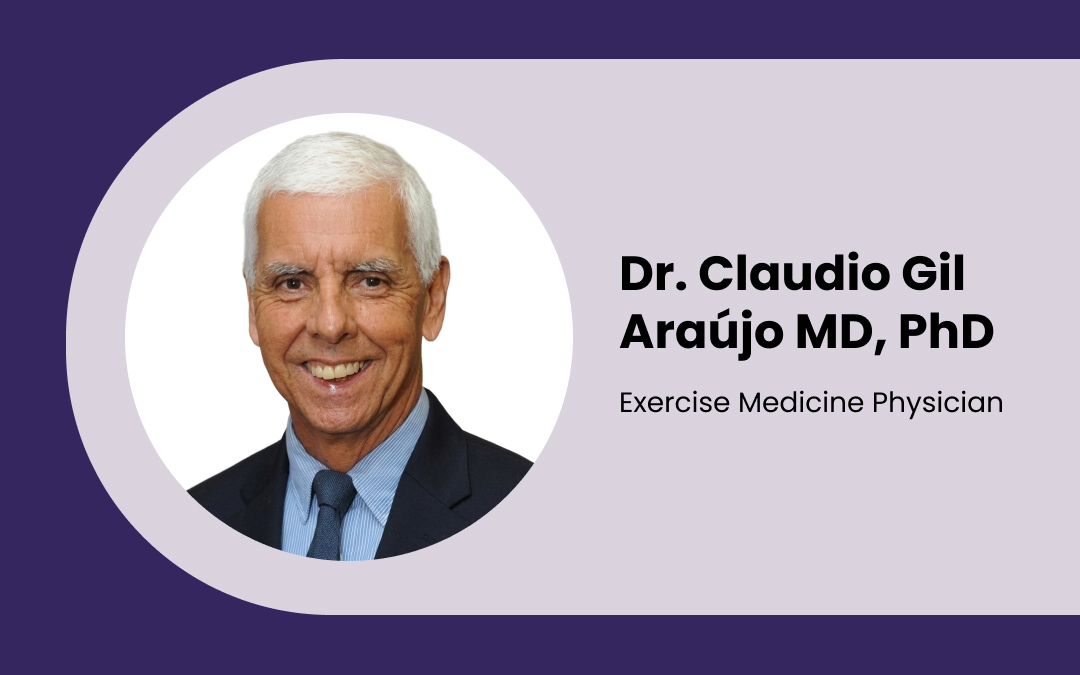
Claudio Gil Soares de Araújo, MD, PhD, is a physician in exercise medicine and Dean of Research and Education at CLINIMEX — Clínica de Medicina do Exercício in Copacabana, Rio de Janeiro, the clinic he founded in 1994. He holds an MD (1979), a specialization in sports medicine (1980), an MSc (1982), and a PhD in biological sciences, physiology (1987), all from the Federal University of Rio de Janeiro. He was a research fellow at McMaster University in Canada during his 1979 internship and returned there for postdoctoral work in physiology and exercise medicine in 1993. He has published more than 250 papers and has lectured in more than 25 countries. Since 1994 his clinic has run an open prospective cohort, the CLINIMEX Exercise cohort, which is the source of nearly all his published findings. He is the author of the Flexitest flexibility assessment method and of the sitting-rising test, and lead author of the 2022 study linking a 10-second one-legged stance to survival. He spoke with Medical Guardian by video from Rio de Janeiro on July 24, 2026.
This conversation has been edited for length and clarity.
On Starting in Exercise Medicine Before He Had a Medical Degree
Araújo has been measuring fitness for longer than most of the field has existed. The path he describes is unusual: he went into physiology rather than clinical practice, and he built the tools before he had the patients to use them on.
You have been in this field a long time. Where did it start?
I started very early in exercise. As a matter of fact, on the first day of medical school we had a medical examination, and they were doing the Cooper test, a 12-minute run used to estimate aerobic capacity. Beside the Cooper test, part of the group was selected to do a VO2 test (a direct laboratory measurement of how much oxygen the body can use at maximum effort, where the Cooper test only estimates that capacity from how far you run in 12 minutes), and I was chosen as one. So, I started my training in sports medicine on the first day of medical school. That was 1974. In 1976 I got a scholarship to visit some labs in the US. I went to the University of Michigan, Indiana University, and the University of Wisconsin. So, I started to work in the area very early, when I was 18, 19 years old. I am 70 now. I have more than 50 years of VO2 and all this stuff.
When I finished my medical training and got my MD, rather than go for residencies and more clinical work, I decided to do the MSc and the PhD in physiology. I was teaching physiology at a medical school at that time, and physical education, so a university career was a better fit. At the same time, I started a cardiac rehabilitation program at the university hospital. I was the leader of that program, so I was involved with cardiology for 25 or 30 years.
I do not entitle myself as a cardiologist. But I have been on the board of directors of the Brazilian Society of Cardiology, always on the exercise side: cardiac rehabilitation, exercise testing, sports cardiology.
You founded CLINIMEX in 1994. What kind of place is it?
It is a very small one. In square meters it is 130. Not much. And perhaps, if you put it by square feet, about 1,400, we have maybe the highest scientific production in the world.
I have always been interested in developing new things. I think I am quite creative. From the very beginning I did not have much equipment. I just had an ECG. So, I said, what can I do with an ECG and a bike? And I developed a test, the four-second exercise test, which uses the heart-rate change during a four-second burst of pedaling to gauge how strongly the vagus nerve is braking the heart.1
Editor’s note: the four-second exercise test yields what Dr. Araújo calls the cardiac vagal index, a ratio of two heartbeat intervals measured before and during the burst of pedaling. A stronger vagal brake generally tracks with better cardiovascular health, and the index declines steadily with age. His reference-value study of 1,605 healthy adults found the median falling from about 1.63 in the youngest group to about 1.24 after 66.
On the Cohort Behind Every Finding
Nearly everything Araújo publishes traces back to one dataset gathered in one small clinic. He is direct about what makes it valuable and equally direct about where it is skewed. By his account the scale is unusual for a single clinic: more than 15,000 evaluations since 1994, roughly 3,800 measurements at each one, and three decades of follow-up linked to official mortality records.
Almost everything you publish comes out of one dataset. What is in it?
Since 1994 we have collected over 15,000 evaluations. And each evaluation produces around 3,800 data points. If you ask me, do they snore? Do they urinate at night? I have all this information.
Because I am a registered researcher with the National Council for Scientific and Technological Development, the CNPq,I can request the mortality data, the official records. From those records we can check who is alive, what the cause of death was, and when it occurred. About 15% of our cohort has died. So, we can separate who died from who did not.
One more thing. Only four physicians collected all the data, over a 30-year period, in the same room.
Editor’s note: when many different people take the same measurement, small differences in how each one does it creep into the data, which researchers call noise. Because only four physicians ever performed these assessments, that source of error is largely removed and results from 1994 can be compared with results from today.
Why do you think that cohort is unusual?
Think about who comes to CLINIMEX to be evaluated. That makes our cohort very interesting and quite unique in the world, because it is a real clinical sample.
We receive top Olympic athletes. We have soccer teams. But I also have a lot of people who come to the clinic just because they are getting fat, they have a belly, they want to lose it, they want to be more active, they want some advice. We see people after myocardial infarction, that is a heart attack, people after heart transplant, people with cancer, people 95 years old who are very fragile and need to do some exercise. On the same day I can have a 10-year-old with a cardiac murmur, then a 40-year-old, then someone 85 years old, and at the end of the day a top athlete.
About 75% of our clients are sick. But 25% are healthy, and some are very, very healthy. So, I can see the full spectrum.
If you look at most studies in the US, the VA studies, who are the normals, the people used as the healthy comparison group? Who goes to the VA hospital as a normal? They normally have at least chest pain, or dyslipidemia, or they are hypertensive. That is how they are normal there. They do not have healthy people there. A sample of people who are all somewhat unwell tells you about people who are all somewhat unwell. Ours has the sick and the healthy in the same room, which is what real life looks like.
Where is your sample biased?
There is a group in it that is different from the general Brazilian population. They live in a big city, in a good area of the city, Copacabana and so on, most of them. So that is a kind of selection, and it is a kind of bias. They are wealthier and better cared for than Brazilians as a whole, so the numbers may not transfer directly to a poorer or less well-treated population.
Apart from that, they are very well controlled. For instance, dyslipidemia does not increase the risk of death in our patients. Why not? Because it is well controlled. Hypertension, a very modest increase in risk.
You restrict your mortality studies to a middle age band. Why not study everyone?
If I take people at 18 years old, and I do have some people at 18 years old, it does not matter what they do or how bad they are, they are not going to die in five years. And if I take someone at 95 years old, it does not matter what he does, he will likely die in five years. So I have to select an age range where the result can still change a decision. Where you can turn your traffic light. Rather than going like a comet, you can change your route.
On What the 10-Second Test Actually Is
The version of the test that circled the world in 2022 is a stripped-down form of something more elaborate. In the clinic, the measurement is quantitative and instrumented. The published pass/fail rule exists so the rest of us can use it.
Walk me through how you run the balance test in the clinic.
We have a platform. The subject stands on the platform and keeps the eyes fixed on a point ahead, on the wall. Then the arms are aligned to the body, and the other foot is kept behind the opposite calf. We test four positions:
- Standing on one leg with the eyes open.
- Standing on one leg with the eyes closed.
- Standing on the first foot, eyes open.
- Standing on the other foot, eyes open.
And we measure the change in the center of gravity.
You do not mention the platform in the paper.
No, because very few people have a way to measure the center of gravity.
How does the platform measure it?
There is a device on the platform. The physician looks at the screen. It measures how many centimeters you deviate your center of gravity in 10 seconds, forward or back, to this side or the other side. Any change at all is quantified and added.
But to make it simple, we started to look at the data and said, if we separate those who were able to hold 10 seconds on one foot from those who were not, we get two clear groups. And let us see the mortality in these groups. And we realized that the mortality was quite different.
Editor’s note: that comparison became the 2022 study. Among 1,702 people aged 51 to 75, one in five could not complete the 10-second stance. Over a median seven years of follow-up, 17.5% of those who failed died, against 4.6% of those who passed. After adjusting for age, sex, body mass index, and conditions including coronary artery disease, hypertension, high lipids, and diabetes, the risk of death was 84% higher in the group that could not hold the position.2
At what age does the average person start failing it?
If you are 70 years old, about 60% of people are able to hold 10 seconds on one leg. The crossing line is around 72 or 73 years.
There are exceptions, and they are usually the trained ones. Just this week we assessed one lady who has been exercising with us for 30 years. She is 97 years old. She was able to stand 10 seconds on one leg. She came to exercise with us after coronary artery bypass surgery when she was 65. She still exercises three times a week in our clinic.
On What the Result Does Not Prove
A finding this striking invites overreach, so it is worth pressing on what the data can support. Araújo does not oversell it.
Here is my worry about the finding. Are people losing their balance because they are dying, or are they dying because they are losing their balance?
It is not exactly a causal relationship, I would say. But it is partially related.
There are two issues with balance, and I should emphasize that I measure static balance. That is something different from dynamic balance. Static balance is holding a position without moving. Dynamic balance is keeping your footing while you are moving, turning, or catching yourself from a stumble. Most real falls happen in the dynamic situation, so a static test is a marker of the system, not the whole picture.
And the test itself is a test. Standing on one leg for 10 seconds in a clinic does not make anyone steadier.
Yes, but there are several ways you can improve your balance.
Editor’s note: the balance training with the strongest evidence base in older adults includes tai chi, the Otago Exercise Programme, and simple standing progressions of the kind Dr. Araújo describes below. Any of them works better as a daily habit than as an occasional session.
On Why the Test Is Pass or Fail Instead of Timed
Most functional tests in clinical use are timed. Araújo argues that timing measures the wrong thing, and that the tasks worth testing are the ones people actually have to perform.
Why score it pass or fail at 10 seconds rather than timing how long someone lasts?
Timed performance is always a bad idea. Why is it a bad idea? Suppose I ask you to do a dead hang. Suppose you get to 20 seconds and I say, okay, I will give you $100 for 10 more seconds. I am tired. $200. Would you get it? Motivation puts a lot of weight on the end of the response. So, the reproducibility is poor.
And at the same time, take the timed five-times sit-to-stand. In what situation in life do you have to sit and rise from the chair five times as quickly as possible? Push-ups. Twenty push-ups. In what situation in life do you do 20 push-ups?
I do them myself every morning, but that is just me.
Yes, because you like it. But if you stop for one year you will be able to do five. It is very specific training. You do not need that.
“If you want to play with your grandkids, you should be able to sit on the floor and rise from the floor.”
So, the sitting-rising test assesses things that are really needed. Because if your glasses fall on the floor and there is nobody there to pick you up, you need to go to the floor and be able to rise again. If you want to play with your grandkids, you should be able to sit on the floor and rise from the floor.
The scenario Araújo describes, alone on the floor with no one to help, is the one that turns a minor fall into a long wait. For those moments, a medical alert system with fall detection can summon help without reaching a phone.
On Training Balance in the Gaps of the Day
Araújo does not prescribe a balance program so much as a habit. The dose he recommends is small enough that the barrier is remembering rather than finding time.
If someone wants to improve their balance, what does that actually look like?
You can incorporate it easily. Balance, if you do three or five minutes per day, is amazing. You see a lot of difference.
You put something in the microwave. You select 30 seconds. Try 15 seconds on one leg, 15 seconds on the other leg. That is it. You are going to brush your teeth. This side on one leg, the other side on the other leg. That is it.
And it is good to do it barefoot and wearing shoes. Because in the street you are wearing shoes, and at home maybe you are barefoot. The motor control is a little different, and so is the balance. Train only the one you practice in and you will be steady in one setting and not the other.
On the Sitting-Rising Test
If the balance test is the one Araújo is known for, the sitting-rising test is the one he would choose. It rolls several components of fitness into a single movement and needs nothing but floor space.
You have built a family of these tests. If someone could only do one, which one?
For sure, the sitting-rising test, or SRT.
The sitting-rising test is great because it incorporates several things at the same time, and when you incorporate several things at the same time, that helps a lot. It measures five things at once:
- Muscle power.
- Muscle strength.
- Balance.
- Flexibility.
- Body composition.
How is it scored?
Put a mat down for safety. Clear the wall behind, have someone supervising, and ask the person to sit down on the floor and then stand back up again. Both halves are scored. It is not complicated. It is simple. If they use one hand, they lose one point. Any support you use, you lose the point. Knee, the side of the leg, you lose points. If you wobble, you lose half a point. You can earn five points sitting and five points rising.
Editor’s note: AARP has published a short video of the sitting-rising test being performed and scored, with a walkthrough in English.
It is tricky. For kids it is pretty easy. When you get older it becomes a little more complicated. If you are overweight, you have a problem. If you are less flexible, you have a problem. If you do not have the strength to hold your body going down, you have a problem. If you do not have muscle power to rise, you have a problem. And if you do not have balance, you have a problem.
How do you know those components are really what the score is picking up, rather than something else?
We assessed each one of them. There is a paper in the American Journal of Physical Medicine and Rehabilitation: does flexibility influence the ability to sit on the floor? Yes, it does.3 And does increased body weight give you a problem? How did we test that? We put a life jacket on people, five kilos. You see that it is much harder to rise and to sit. So body weight interferes. We are pretty sure now that these things are related to the result.
It is not the sit-to-stand test that American clinicians already use.
It is different. There is one famous test in the US, used by the CDC, sitting on a chair. It is different. In the CDC test you count how many times you can rise from a chair in 30 seconds, so it is timed and it starts from seat height. Ours is not timed, it starts from the floor, and it is scored on how much support you need to get there and back.
Put the mortality numbers in context for a reader.
If you have high cholesterol and you do not treat it, for whatever reason, because you do not like it or you do not know, you double your chance to die. If you have high blood pressure and you do not treat it, you double your chance to die. If you smoke and you do not quit, you double your chance of dying. If you have diabetes and you do not treat it, you triple your chance of dying.
But if you have a poor result on the sitting-rising test, you increase by five your chance to die. Five times. That is more than smoking, more than untreated blood pressure, more than untreated diabetes, from something you can check on your living-room floor.
And it takes 20 seconds to do. To assess at home.
Editor’s note: Dr. Araújo’s comparison figures for cholesterol, blood pressure, smoking, and diabetes are clinical shorthand rather than results from his cohort. His sitting-rising figure comes from a 2025 study of 4,282 adults aged 46 to 75, followed for a median of 12.3 years. Death rates ran from 3.7% among those scoring a perfect 10 up to 42.1% among those scoring 0 to 4. After adjustment for age, sex, body mass index, and clinical variables, the group scoring 0 to 4 had 3.84 times the risk of death from natural causes and 6.05 times the risk of cardiovascular death compared with the perfect scorers.4 An earlier 2014 study first linked the test to all-cause mortality.5
On Muscle Power Versus Muscle Strength
Strength gets measured. Power, which is strength delivered quickly, usually does not. Araújo argues the distinction is practical rather than academic, and his cohort data support him.
You have written that muscle power outperforms muscle strength in predicting mortality. What is the difference between the two?
That is the missing link. Power is force times velocity. So, I can lift 20 kilos slowly, or I can lift the same 20 kilos fast. Same weight, same movement, and that is substantially different.
When you get on an airplane, you have to put your carry-on in the overhead compartment. You need power, the fast movement, because if you go slowly, Newton’s gravity will pull you down. So, you have to be quick, otherwise you are not going to be able to do it. If you go to the grocery store and you want to pick up the groceries, you need power. To carry, you need strength, the slow carry where speed does not matter. But to pick up, you need power. To rise from the chair, to go up stairs, to get out of the car, you need power. And if you go to sport, everything is power. When you serve in tennis, when you serve in volleyball, when you kick in football, it is power.
And power declines differently than strength does.
You start to lose muscle power and force around 30 years old. You lose force, but after 60 you lose speed quite quickly, faster than you lose strength. Power is force multiplied by speed, so when the speed goes the power goes with it, even while the strength is still there. That is the reason a person at 80 has a problem rising from the chair. Not because he does not have strength. He has the strength to hold the grandkid in his arms. But he does not have the power to rise from the chair with the grandkid in his arms.
Most people over 65 have heard of sarcopenia. You use a different word.
Sarcopenia is just low muscle mass, by the Greek roots, sarx for flesh and penia for lack. Poor muscle strength or poor muscle power is dynapenia. And why is it important to make the distinction? Because if I want hypertrophy, that is one kind of exercise. If I want power, it is another exercise.
Editor’s note: a 2025 study of 3,889 adults aged 46 to 75 from Dr. Araújo’s cohort compared the two directly. Over a median of 10.8 years, people in the lowest category of relative muscle power had 5.88 times the mortality risk of those in the highest among men, and 6.90 times among women. Handgrip strength, which measures strength rather than power, did not reach statistical significance once age, body composition, and medical history were accounted for. The practical contrast is that power distinguished risk in this cohort where handgrip strength did not reach significance, though both power estimates carry wide margins, so the direction of the finding is firmer than its size.6
So what does power training look like, in practice?
Most people are used to doing 10 or 15 reps, somewhere between 10 and 15. When they do that, I know they are doing it wrong. How do I know? Because we do not have the energy substrate to do 10 or 12 or 15 good reps. So you are likely watching TV, watching Netflix, doing it like that. You are doing relaxation, anti-stress training, whatever you want to call it, but you are not getting muscle power.
You only have substrate for six or eight reps. So, if you start to slow down, you can stop. But you only need 15 to 20 seconds to replenish the energy stores. So, what do I do? Like this, and like this, and then back again, lifting the weight fast and returning it under control. That is it. In 15 minutes you are done. Go home. Give some time to balance, give some time to flexibility.
How do you split it across the week?
Just go for the major muscle groups. Every other day is okay. If you have a special desire, if you want to throw a ball as quickly as possible, work more with that group. That is it. It is very simple.
Is there an injury risk in moving fast?
Some people say, oh, you may get an injury doing it quickly. No. You get an injury when you perform the movement badly. Nobody kicked a ball well and got injured, because they know how to kick the ball. But if they hit the ball badly in tennis or volleyball, they can get injured.
And you can say, okay, that is good for young people. No, no. Older people do it very nicely. Eighty, 90 years old. Sometimes they are afraid. You go with them and show them they can do it.
On the Component Nobody Measures
Flexibility is the fitness component most often prescribed and least often assessed. It is also, in Araújo’s account, the easiest one to improve, which is what makes the gap frustrating to him.
Flexibility is the piece of this you have worked on longest.
Everybody says, oh, do flexibility training when you go to the gym. Maybe you have a wall poster and you do some movements because you see them on the wall.
But flexibility is very important for autonomy, for prevention of falls. Why does a kid fall on the floor, cry for one minute, and it is okay? And if an adult or an older person falls on the floor, it is a major problem. One of the reasons is that they do not have the range to absorb the energy when they fall, because they are not flexible. Kids are flexible. They can hit the floor and there is no problem at all.
And flexibility is the variable where we start very high as a baby and lose all life long. A 15-year-old has less flexibility than he had at five years of age.
How did you end up building your own test for it?
There was a test called sit and reach. You try to put your fingers on the top of a box. But it measures one movement, essentially the hamstrings and the lower back. And you can be flexible in the arms and the shoulders and not flexible in the wrist, or in the ankle, or in the trunk.
So, we devised a method called Flexitest that evaluates flexibility in 20 movements. The whole body, seven major joints: ankle, knee, hip, trunk, wrist, elbow, and shoulder. Each movement is graded from 0 to 4, so the total goes from 0 to 80. And the method is very simple, because it does not need any equipment at all.7 You do not have to do anything. The evaluator performs the movement for you.
Why do you think flexibility gets recommended constantly and measured almost never?
I wrote an editorial about that a few years ago. The title is: flexibility exercises are often recommended but flexibility is rarely evaluated. A misconnection.8
You go to the gym, you may have your personal trainer, he goes to the machines and says, okay, move this stack, this many times. And the stretching? Okay, just follow the wall, do some movements. But which movements are important? Are you good in the hip, or maybe not in the ankle? Nobody cares. That is a big mistake. A missed opportunity.
Editor’s note: Dr. Araújo’s own answer to the assessment gap is the Flexitest, which he describes below. His 2004 book sets out all 20 movements and the 0 to 4 scale, and the normative tables let a result be read against others of the same age and sex.
How trainable is flexibility, compared to the rest?
Flexibility is easily trained. To improve your VO2 you have to spend hours of aerobic training, or very high intensity aerobic training. But to improve flexibility, you may need 10 minutes a day.
I used to say something to my patients. If you were the fastest sprinter in the world and you came to me and said you would like to run the 100 meters faster, I would answer, you are already very, very high, because you are the best in the world. How can I improve you? But if you are a poor student, it is very easy to improve your grades, because you just study. The one who is an A or A+, the sprinter in my example, I cannot improve. But the one who is a C or a D, okay, just by studying, you improve. The same with flexibility and all the other things.
Some people come to me and say, I am able to run a half marathon in under two hours. Okay, great. What about flexibility? Oh, I am poor, very poor at that, I do not have time for flexibility. That is a wrong story. If you can run for hours for aerobics, why not have five or 10 minutes a day for flexibility? People like to do what they are good at, and this is a wrong concept.
Because at school you have to pass in all the disciplines. English, math, all of it. It does not matter whether you like it or not, you have to be above the median. The same with all the components of physical fitness. To be physically fit you have to be good in aerobic, and muscle power, and flexibility, and balance, and all of them. If you are good in three of them and losing two others, you may fall and break your leg.
Can someone in their sixties who has never stretched actually move up the distribution, or only improve a little?
Yes, we did look at that. Let me show you a real report. This person was first evaluated in 2010. He has eight measurements. His first evaluation, at 53, was 30 points. Now he is 68 and he has 36 points.
At the first measurement he was in the 26th to 40th percentile, below the average.9 Now he is almost in the top 15 or 20 for his age group. He is getting better and better, like wine. He is getting older and better.
What changed for him?
He is a businessman. As he got older he passed the business to his kids, to his son and daughter. Now he is partially retired, just watching on camera how the stores are going. And he spends mornings doing exercise, riding the bike, stretching, doing yoga. His cholesterol is better now. His VO2 is better now. Everything in his life is better.
Is there a way to assess flexibility outside a clinic?
Apply the Flexitest. But there is one limiting issue with the Flexitest, especially in the US. As you saw in the pictures from the book, the evaluator puts their hands here and there. There is a lot of physical contact with the person being evaluated. In some places in the US, in the hospital it is okay, but at a school, at a company, you are not supposed to touch them. If you go to Asia, that is not a problem. If you go to many other places, it is not a problem. It is a cultural issue.
But we have another method to evaluate flexibility now that is simple and does not need physical contact. We have a lot of individuals and we validated it against the Flexitest. It sounds pretty good. It is a good screening tool for a beginner, if you do not want physical contact. And one advantage is that it could be done at home, self-administered. We hope to have it published soon.
On Why Women Outlive Men
Near the end of the conversation Araújo turned the questioning around. He does not claim to have solved the puzzle, but his data point at one variable that behaves differently from all the others.
You said you had a challenge for me.
In most physical fitness tests, VO2, muscle strength, power, men outperform women. Definitively. But women live longer. Why?
I would have guessed blood pressure.
It is not the case. The difference in blood pressure is small, especially after menopause.
I do not have the answer. I would get a Nobel Prize if I did. But I have some hints. There is one single variable where women are much better than men. Flexibility.
And that connects to the fall problem you described earlier.
That makes a lot of difference, because when they fall they have less chance of being hurt.
Editor’s note: US data supports the pattern Dr. Araújo describes, though it cuts both ways. CDC surveillance found that in 2020 women reported more falls than men, 28.9% against 26.1%, while in 2021 men died from falls at a substantially higher rate, 91.4 per 100,000 against 68.3. Women fall more often and are hurt less badly when they do. The CDC report is here.
And here is another interesting thing. On the sitting-rising test, men and women perform equally. Why? Because men are better in strength and power, and women are better in flexibility. They balance each other. Balance itself is very similar between them.
Editor’s note: Dr. Araújo’s cohort study of body flexibility, published in 2024, found that women scored 35% higher on the Flexitest than men, and that low flexibility was associated with higher mortality in both sexes. The association was stronger in women, though the confidence interval around the female estimate was wide.10
On What Comes Next
Araújo is partially retired and unhurried about it. Several results are sitting in the cohort waiting to be written up, and he sees no competition for them.
What is still in the pipeline?
The four-second exercise test. We have been working with that for over 30 years. We have published a few papers on it, but we still have not published the big one, the one showing mortality. I think in the next six months or one year we will have it.
And the one I expect to do pretty soon is to combine both things. We know aerobic fitness is very good. Our cohort shows that. To be fair, many cohorts have shown the same. It is not a novelty. But what about combining a good sitting-rising test and a good VO2? Should one of them be enough, or is it better to have both?
We are planning it easily, around my partial retirement. I do not have to rush, because nobody has the data. Only we have it. Everybody who starts to do this is 20 years late.
Your 2022 balance paper went further than most research ever does.
The balance paper has over half a million downloads. I have given interviews to the Washington Post, The Guardian, the New York Post, the New York Times, the Wall Street Journal. A Korean television crew came to our clinic and made a program about the balance test.
Editor’s note: Dr. Araújo’s work reaches beyond fitness testing. He is a co-author of the KiTOMI model, published in the Canadian Journal of Cardiology in 2016, which gives clinicians a graded way to counsel heart patients on resuming sexual activity after a cardiac event.11
What I like is that my research is simple, but still very much evidence-based, solid research. And it is applicable to everybody. If you search today for the sitting-rising test, you see hundreds of Instagram posts every day, people showing how they performed. So that is a legacy. I leave a legacy. That is my pleasure.
Where do you most want the tests used?
I like to visit hospitals more than congresses, because congresses are limited. So I like to go to the hospital. And people start to use the test.
References
1. Araújo, C. G., de Castro, C. L. B., Franca, J. F. & Ramos, P. S. 4-Second Exercise Test: Reference Values for Ages 18–81 Years. Arq. Bras. Cardiol. 104, 366 (2015).
2. Araújo, C. G. et al. Successful 10-second one-legged stance performance predicts survival in middle-aged and older individuals. Br. J. Sports Med. 56, 975–980 (2022).
3. Brito, L. B. B., Araújo, D. S. M. S. & Araújo, C. G. S. Does flexibility influence the ability to sit and rise from the floor? Am. J. Phys. Med. Rehabil. 92, 241–247 (2013).
4. Araújo, C. G. S. et al. Sitting-rising test scores predict natural and cardiovascular causes of deaths in middle-aged and older men and women. Eur. J. Prev. Cardiol. https://doi.org/10.1093/EURJPC/ZWAF325 (2025) doi:10.1093/EURJPC/ZWAF325.
5. De Brito, L. B. B. et al. Ability to sit and rise from the floor as a predictor of all-cause mortality. Eur. J. Prev. Cardiol. 21, 892–898 (2014).
6. Araújo, C. G. S. et al. Muscle Power Versus Strength as a Predictor of Mortality in Middle-Aged and Older Men and Women. Mayo Clin. Proc. 100, 1319–1331 (2025).
7. Arau´jo, C. G. S. de. Flexitest: An Innovative Flexibility Assessment Method. (Human Kinetics, Champaign, IL, 2004).
8. araÚJo, claudio G. Flexibility exercises are often recommended but flexibility is rarely evaluated: a misconnection. J. Sports Med. Phys. Fitness 63, 1135–1137 (2023).
9. De Araújo, C. G. S. Flexibility assessment: normative values for flexitest from 5 to 91 years of age. Arq. Bras. Cardiol. 90, (2008).
10. Araújo, C. G. S. et al. Reduced Body Flexibility Is Associated With Poor Survival in Middle-Aged Men and Women: A Prospective Cohort Study. Scand. J. Med. Sci. Sports 34, (2024).
11. Stein, R., Sardinha, A. & Araújo, C. G. S. Sexual Activity and Heart Patients: A Contemporary Perspective. Canadian Journal of Cardiology 32, 410–420 (2016).
Dr. Eliezer (Eli) Lichter
Dr. Eliezer (Eli) Lichter brings a rare combination of hands-on clinical experience and rigorous scientific training to his work as a medical writer at Medical Guardian.
Before entering research, Eli served as an emergency medical technician in Yonkers, New York, one of the state’s busiest urban EMS systems, where he was recognized with multiple Lifesaving Citation Awards. That work put him on the front lines of exactly the crises Medical Guardian exists to prevent, including fall responses involving older adults. He later served in an administrative role at a large skilled nursing facility in upstate New York, where he managed the full operational complexity of senior care, including fall prevention protocols and incident response.
That direct, real-world exposure to what aging adults and their families face every day shapes everything he writes.
Eli earned his PhD in Biochemistry and Molecular Biology from the University of Nebraska Medical Center, where his research focused on the genetic mechanisms underlying neurodegenerative diseases, including Alzheimer’s and Parkinson’s disease. He then completed postdoctoral training at Boston University in computational biomedicine, including a research affiliation with the Broad Institute of MIT and Harvard, developing molecular and computational strategies for early detection of cancer, Alzheimer’s disease, and other serious conditions through advanced applications in genomics and epigenetics.
At Medical Guardian, Eli translates complex medical and scientific research into clear, trustworthy content that helps older adults and their families make informed decisions about their health, safety, and independence.